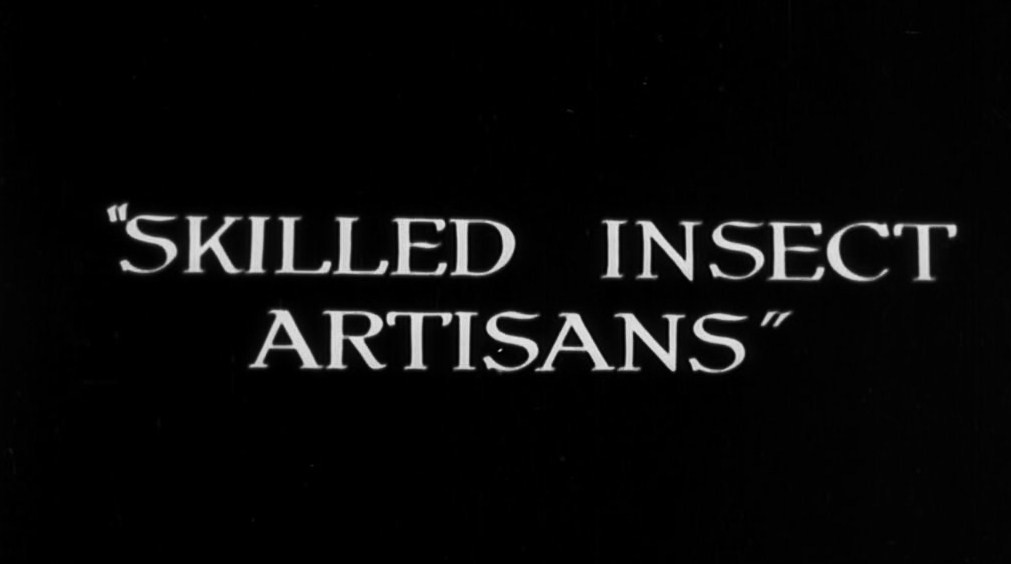
Some title cards from the early British documentary series 'Secrets Of Nature'. That's the titles for my next imaginary album sorted, then.
Monday, 16 September 2013
Sunday, 15 September 2013
Chasing the Blues
'Cotton Kings! Are the medieval conditions and dangerous working practices in your dark satanic mills affecting productivity and cutting into your profits? Well, why not spend a few quid you miserable bastards!'
'Chasing The Blues' is a short, frothy film from 1947 which extols the virtues of tidying up the workplace and installing brand new fangled facilities like running water, toilets and canteens. Change is personified by Mr. Will and Mr. Way, two lively dancers from Sadlers Wells who rampage around the mill wielding paint brushes and putting in showers, all the while pirouetting and kicking their legs up to a jolly swing soundtrack by Jack Parnell.
She's happy, she's just been able to join the 20th century by having a wash at work. Next stop: get those teeth sorted!
The price of progress is neatly shown in terms of increased output and profits rather than cost - an appeal to the head rather than the heart via the wallet - guaranteed to make sense to even the most Dickensian mill owner.
Energetically and innovatively done, 'Chasing The Blues' owes a lot to Len Lye's jazzy films for the GPO (co-director Jack Ellit had worked with Lye extensively). The most extraordinary thing, I suppose, is that this film was made in 1947, and was targeted at places which, despite having a workforce of thousands, still didn't have places for them to wash their hands or eat their sandwiches.
Thankyou Mr.Will and Mr. Way -but not for your bastard grandchildren, Mr. Health and Ms. Safety.
Saturday, 14 September 2013
Agonizing Horror
‘The Trollenberg Terror’ (aka ‘The Crawling Eye’ in territories where they want it all spelling out for them) is a tight, cheap little film adapted from an ITV presentation which, presumably, was even tighter and cheaper and littler.
It doesn’t sound much, but I’ve always found it extremely entertaining and occasionally pretty dark, with several nasty beheadings and some weird alien mind control shit that turns perfectly nice people psycho. Much of the violence is directed towards a poor young woman who, unfortunately for her, has mediumistic qualities. The aliens hate this because she’s onto them and their dirty schemes, so strive to get her knocked off at every available opportunity, the cheeky, slimy baskets.
It all ends in a big bonfire and the aliens learn, as so many do, that humans may not be able to fly around the universe causing problems but, by Christ, they can certainly KILL. The climax is often mocked for its extensive use of models and stop-motion camera work but, unsophisticated as it is, it works in the context of the film, so don’t sneer at them, smart-arse, that’s like having a go at Vasco Da Gama for not using a sat-nav, i.e. wrong.
Friday, 13 September 2013
Dreaded Man-Beast Of Tibet
Regular readers will know that we love Nigel Kneale on The Island. ‘The Abominable Snowman’ is not one of his best known works, but it is an excellent example of Kneale’s brilliance, his compassion and, most of all, his unerring ability to turn a stock dramatic situation completely on its head.
Originally made as ‘The Creature’ for TV with Stanley Baker, Hammer eagerly snapped up the story as a counterpoint to their hugely successful ‘Quatermass’ adaptations. It stars Peter Cushing and Forrest Tucker as two men both in search of the Yeti, but with completely different motives: Cushing, of course, wants to make contact out of personal and professional curiosity, to study the creature from a scientific point of view and further man’s understanding of the world he lives in; Tucker wants money and glory, and doesn’t care how many big footed snow monsters he has to kill to get it.
The climax of the film, in which a concussed Cushing ‘meets’ the Yeti in their home environment, has a sense of subtle satisfaction for the fair minded. The creatures remain in the shadows, half-glimpsed, retaining their mystery. Most importantly, they clearly think that mankind is pretty abominable and they are simply biding their time waiting for us to blow each other up once and for all. It’s a wonderfully gentle ending to an intelligent and well-made film.
I also like the music, which rips off Ralph Vaughan-Williams marvellous score for ‘Scott Of The Antarctic’ extremely well, something RVW did himself for his seventh symphony.
Nigel Kneale, Hammer, Stanley Baker, Peter Cushing and Ralph Vaughan Williams all in one post? I spoil you, I really do.
Thursday, 12 September 2013
All Aboard
If you're in South Yorkshire, or would like to briefly visit, remember to swing by Doncaster Minster from 7.00 pm on Friday 13th for their very first film night. For a mere five quid you get 'The Flying Scotsman' (1929) and 'The Lady Vanishes' (1938). How do I know? I'll be there, choc ice in hand, introducing the blooming things.
Liberators
Up until a few weeks ago, I hadn’t watched an episode of ‘Blakes 7’ since the original show came to its controversial close in 1981. Over the years, despite once being a fan, I had mentally packed it away under ‘rubbish’ and put it into brain storage. Prompted by my friend and colleague Fearlono’s constant texting about various elements of the programme, however, I decided to revisit it. I believe they call that ‘peer group pressure’.
I’m not going to pretend that it’s the greatest programme I’ve ever seen, but I have to admit that I was wrong - in fact, it’s dark and sombre and serious - proper dystopic sci fi space opera – and all set in a depressingly squalid future.
Blake may be an idealist (although he is prepared to put others at risk for his beliefs), but the rest of his crew are, by and large, scumbags. Villa is a thief, Jenna a smuggler, Avon a borderline psycho with a Messiah complex. Only Gan (my favourite as a child) has an excuse for his criminal record – he killed the man who murdered his ‘woman’ – and suffered an experimental brain implant that limits his capacity for violence as a result. Basically, they are lawless fugitives but, because Blake has principles, they occasionally blow something up or jam a Federation signal and, subsequently, have created the legend that they are freedom fighters, a desperately needed commodity in an appallingly restricted world.
Under the jackboot of The Federation (or the high heel of Servalan, if you like, and a lot of people do), the entire universe has been turned into a machine to serve the evil empire – a grey, dirty conglomeration of factories and refineries, scrappy colonies and half-abandoned research stations on barren, unforgiving planets. Half of the people are slaves, the other half fascists and quislings. So called ‘inferior’ races labour away in mines until malnutrition or radiation poison kills them. It’s depressing as hell, not a hint of glitter or brave new world. Resistance is met with death (the series opens with a massacre) or torture and disgrace (they frame Blake for child molestation in order to destroy his reputation). If you’re lucky, you get your brain wiped and get to start again.
This is the real future of humanity: living on a slag heap, working like dogs, kept in check by a ruthless, faceless police force and crappy robots, scrabbling around trying to survive for no other reason than instinct. It all seems completely pointless. There is literally no-one in this world who enjoys life or living. Power must be its own reward because, apart from an increasingly outlandish array of white outfits, even supreme commander Servalan seems to simply rattle between space stations and quarries, endlessly tramping around in high heels and being menacing without ever actually getting anywhere. It’s a chilling and, I think, pretty accurate picture of what things will be like in 700 years: shit. The only thing the show does get slightly wrong is that everywhere seems semi-inhabited rather than teeming with over-population, but perhaps there was a plague or something equally catastrophic. It wouldn’t surprise me, it feels like the End Of Days now.
So, ‘Blakes 7’ – not rubbish, not rubbish at all.
Wednesday, 11 September 2013
Subscribe to:
Posts (Atom)


.jpg)