Showing posts with label 1960. Show all posts

Thursday, 27 June 2013

Off The Job


Finally, the sequence in 'Stone Into Steel' where it all goes weird and the music gets clattery and we see into the men's heads and get glimpses of their public and private passions, gaining an insight into what they do when they're not at work. In the case of the last picture, he seems to be doing Pat Butcher.

A Sense Of Proportion


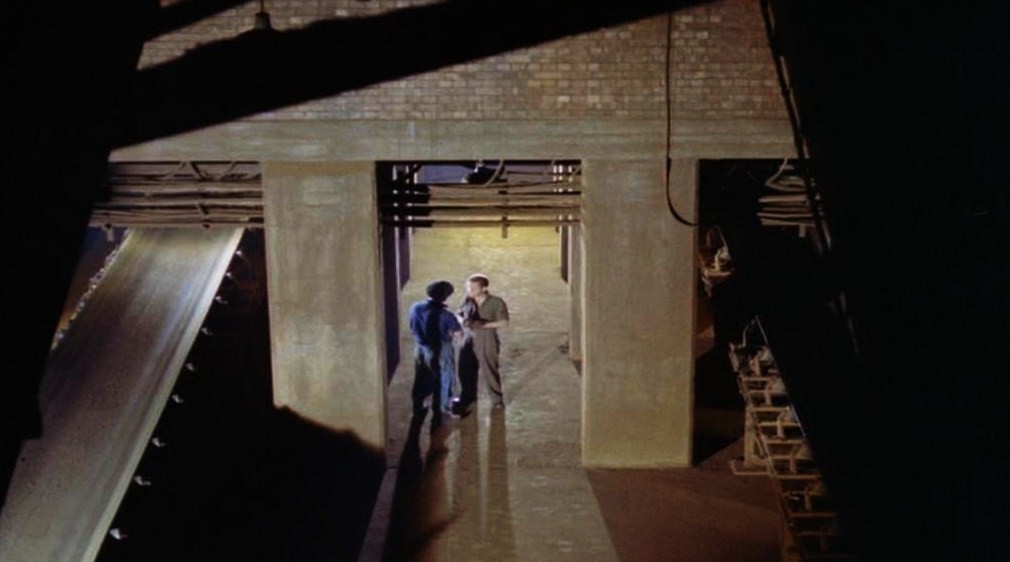
More from the marvellous 'Stone Into Steel', with a selection of shots designed to put across the sheer scale of the operation in sunny Scunny, and the relatively few and infinitely tiny human beings needed to keep it all going. 

Wednesday, 26 June 2013

Life On Mars


The vast alien landscape of the Appleby-Frodingham steelworks in Scunthorpe, as seen in the super duper 'Stone Into Steel'. How do I know the name of the steelworks? Extensive research, instinct, and a small clue within the film itself..


Stone Into Steel


I watch an awful lot of documentaries, public information films and the like. I don't know why, I like them and they make me feel happy and contented and, strangely, full of hope for a long gone age, usually one that I didn't ever experience myself. Some of the films are deadly dull, of course, but most make for riveting viewing, especially the ones about ship building. That was a riveting joke, by the way. 

My favourite film of many favourites is 'Stone Into Steel', from 1960. It shows us the process by which iron ore is extracted from rock and, eventually, turned into battleships and radio telescopes. It does all this in just over half an hour and, apart from some opening captions, no other explanation other than what we see on the screen - no dialogue, no commentary, just the odd bit of ambient noise and an ever changing modernist classical score by Edward Williams. Every frame is beautiful, and although the pace is gentle, it's never boring even if, like me, you have no specific interest in the steel industry. It was directed by Paul Dickson, who later went on to make episodes of 'Department S' and 'Jason King' - clearly, a very talented man.  

Frustratingly, I've been unable to illegally reproduce my nice, bright version of the film, so, if you're interested, for now you'll have to watch a scabby, faded copy on You Tube. Start here.

Thursday, 25 April 2013

Take Your Own Thunder With You

'Want to fly a Lightning? Want to occupy the single seat in the single seater,
all leather, night and day, high flying, supersonic, supernormal Lightning?'


Jet age, jazz poetry, advertising hip. The RAF was clearly pretty happening in 1960, and the English Electric Lightning was the living end, Daddio.

Tuesday, 23 April 2013

Travelator

The London Underground is one of the greatest engineering achievements in British history. If, like me, you sometimes take it for granted, then lovely little films like 'The Travelators' (1961) help remind you of the scale and sheer amount of graft that go into its maintenance and constant updating, let alone the original construction.


The film details the building of two travelators at the Bank station. These were the first in Europe, and a huge shaft had to be sunk under the road in one of the busiest parts of London. Scale models were used extensively in the planning and building process. I like scale models very much. If I had to write an episode of 'The Twilight Zone' it would be about a lonely modelling enthusiast who finds a way to live in a scale model, and ends up enjoying it much more than life in the big world. 


Work started on the Bank site in August, 1957, and was completed three years later. The travelators were opened in September, 1960 by the Lord Mayor of London, who was also the first person to officially travelate. After the dignitaries had their photograph taken, the 'moving pavements' were opened up to the general public, who seemed to really enjoy the innovation. People were easily pleased in the olden days, weren't they? I'm not knocking it, it's a good way to be. 


Note misspelling of 'travelator'

Look how clean it all is!

Look how happy they all are!


In case you were pondering the difference between a travelator and an escalator, by the way, it's the absence of steps.

Monday, 19 November 2012

The Strange World Of Gurney Slade

'A half hour television show. Half an hour to put the world right.
What can you do in half an hour? I need at least forty minutes'.

'The Strange World Of Gurney Slade' was originally shown between the 22nd of October and the 26th November, 1960. It’s one of the most radical pieces of television ever shown in this country, not because it attempts to turn the world upside down (although it does, in a small way) but because of how far away it was from the entertainment of the time. Indeed, it's still slightly baffling today.

Ostensibly a sitcom, the show stars polymath / show off Anthony Newley. Newley is the semi-forgotten man of British entertainment, perhaps because he disappeared off to Hollywood as quickly as he could. A man of several formidable talents: songwriter, actor, pop star, writer, egomaniac, Newley had been acting since his teens, and been having big hit singles since 1959. ‘Gurney Slade’ must have appealed to his well-developed sense of the absurd, his intellectual, sardonic sense of humour and his life-long desire to appear slightly hipper and smarter than everybody else. It also contained pathos, and Newley loved pathos – and his sad clown’s face was always able to communicate it brilliantly.


We begin by watching a scene familiar from dozens of soap operas, a friendly chat around the living room. There’s a fairly typical family unit and an annoyingly friendly neighbour, the talk is of roses and the weather and how you like your eggs doing. At the edge of the group, however, is a little man who is becoming increasingly agitated. It’s Gurney Slade. Eventually, he stands up and puts his coat on. Offstage they try and feed him his lines, while the rest of the cast try and stay in character but Gurney gets up and leaves the studio shrugging off objections from a young Geoffrey Palmer and escapes out onto the street.


Free at last?
And that’s it in terms of plot. From here on in, anything can happen, from Gurney holding conversations with dogs and dustbins to dancing with a girl who appears out of a Hoover poster. It’s Una Stubbs, by the way, and she certainly can cha cha cha. Each episode has a different focus, a different feel, a different subject for Gurney to meditate upon (he spends a lot of one show pondering the counter sunk screw). In early episodes it's part Hancock, part Camus, part Buster Keaton, but it gets progressively more idiosyncratic as it goes along. It’s not quite a stream of consciousness, but the preferred delivery method is internal monologue, and some of the drama is strange and blurred and dreamlike - a stream of unconsciousness, if you like.
Although developed and written in collaboration with Dick Hills and Sid Green, 'Gurney Slade' is an early exploration of two of Newley’s life long personal and artistic obsessions - himself, and the battle of the ordinary man against society, the fight for survival of the self against conformity and drudgery. Newley’s next project was the phenomenally successful musical ‘Stop The World, I Want To Get Off’ in which he played a character called ‘Littlechap’, a malcontent permanently searching for spiritual and sexual fulfilment - at the expense of those who really do love him.

In his later x-rated film musical 'Can Hieronymus Merkin Ever Forget Mercy Humppe and Find True Happiness?' (1969), an epic flop and masterpiece of artistic self-indulgence, profligacy and experimentation (like 'Gurney Slade' it was post-modern before the term gained common currency), Newley turns the most intimate details of his real life (his divorce, the death of his first child) into garish knockabout farce. 'Gurney Slade' is the first manifestation of this contradiction: the show off who wants to be left alone; the introvert who tells you all his business. At the end of the first episode of 'The Strange World Of Gurney Slade', for instance, a dyspeptic Gurney walks into the distance, dragging a hoover behind him and ranting:

“I'm a walking television show. I can't get away from 'em. Big Brother is watching me, and Big Dad and Big Mum. The whole family's watching me. I'm like a goldfish in a bowl. I'm a poor squirming squingle under a microscope. Leave me alone. Leave me alone, will you? I've got a right to my privacy...switch me off."

How typical of Newley to make a tv show about not wanting to make a tv show. 

Tony and Anneke Wills. They had a child together.

Gurney flexes his mandibles.

Gurney Slade is a real place, Cuckolds Comb not so much.

Dreamscape / bizarre bomb site.
As anyone who has seen both shows will have noticed, there are definite parallels between ‘The Strange World Of Gurney Slade’ and that other masterpiece of oblique British telly ‘The Prisoner’. Like Number Six, Gurney resigns without disclosing his reasons, walks out, and, like Number 6, finds himself adrift in a surreal, artificial world where everyone is playing a part. There is seemingly no escape, and no real explanation, only the desire not to be subsumed by the system. Ultimately, there will be answers of sorts, but they won’t necessarily be particularly welcome. The similarity is not just thematic: the structure of two of the episodes prefigure ‘The Girl Who Was Death’ and ‘Fall Out’ respectively.


Although the critics liked it, 'The World Of Gurney Slade' was not a big hit with the general public, and, after three episodes, with reactions running from bemused to annoyed to bored it was moved from prime time to an 11.10pm slot - in a world where most telly watching people went to bed at half past nine. As it became apparent to everyone that 'Gurney Slade' was not going to be a success, Hills, Green and Newley took it to new levels, even incorporating the negative reception of the programme into the programme itself. In the fourth episode, Gurney is put on trial for having produced a poor show and having no sense of humour. He is found guilty.


The last episode of the series has Gurney confronted by his own characters, figures of his imagination made flesh who, at the end of the show, will simply disappear. This Pirandello-esque conceit works well especially when, in a brilliant and disturbing twist, it becomes clear that Gurney Slade is as much an invention as they are. It’s hard to think of any British television show with such a bizarre ending.

Gurney's evil side.

Invisible Elephant.

On Air.

Nine characters in search of an exit.

The Crooner.

The Dummy.
Newley, of course, went on to bigger things, then, eventually, when his flops outweighed his hits and he started to get tired and drunk, much smaller things. His last appearance was as a weary gangster in ‘Eastenders’, but illness prevented him from becoming a regular character. He died in 1999, too early, of renal cancer and a surfeit of living, his ‘Richard III’ musical only partially completed.

The Talented Mr. Newley.
Newley was a rare and unique talent, but his genius was always odd and brittle, slightly ridiculous and prone to falling over at crucial times - at his best he is always trying hard, going too far, doing too much - deeply brilliant, deeply  flawed - but that's got to be better than boring old perfection, hasn't it?