Showing posts with label 1978. Show all posts
Thursday, 20 February 2014
Gawpers
Aliens could land in Trafalgar Square and exit their flying saucer on the backs of unicorns while a 78 year old Elvis sings ‘The Wonder Of You’ and, you can bet, if the media are present, some gormless British person will ignore what’s happening right in front of them to turn around and gawp at the camera.
Example 1: this fellow is not interested in Jimmy Pursey and Sham 69’s request for their friend Harry to get a move on: he just wants to look questioningly into the camera and get his slightly defiant face into ten million homes. Well done, Sir, mission accomplished.
Thursday, 13 February 2014
The Golden Age Of Top Of The Pops
Friday, 27 September 2013
What's His Game?
‘The Stud’ may have seemed the perfect suburban adult entertainment in 1978, but today the signifiers of sophistication displayed in the film (furs, cocktails, poppers, loafers, top loading VCR's, Joan Collins) give it a laughably kitsch appeal that just about make up for its shortcomings as a work of art.
Based on a best selling ‘novel’ by Jackie Collins, the film tells the story of an ambitious London nightclub waiter turned greeter turned club manager Tony Blake, played by saturnine Swiss actor Oliver Tobias. Tony wants his own club but, in the meantime, is stuck with ‘Hobo’ (absolutely nothing like ‘Tramp’), a swinging cellar populated by wealthy and unbearable middle aged people making jokes about child molestation, Legs and Co. dancing and a cool black DJ in a great big cowboy hat playing Leo Sayer records.
On top of this (literally) he has to contend with his boss, bored socialite Fontaine Khaled (played by Jackie’s sister Joan) who sees Tony’s frequent and vigorous affections as part of their working relationship, and has no qualms about letting him know this on a regular basis. What unfolds over the course of the next hour and a half is a tacky maelstrom of recrimination, class consciousness, disco, angry parrots, homosexual assault, wrinkly nudity, uncomfortable looking lift sex, uncomfortable looking swing sex and an eight minute filler sequence where Tony simply drives through the countryside in his MG.
Glowering Tobias gives a fairly wooden performance, and Joan Collins, as ever, makes your skin crawl. The film itself is obviously low budget, dimly lit and poorly located, re-using shots over and over and slumping unceremoniously from one scene to another. The result is a slightly crushing experience, detailing as it does the depressing, sleazy lives of idiots in a dingy, miserable world where prostitution and borderline paedophilia are presented as the zenith of jet set glamour.
In its defence, the film is very funny on all sorts of (mainly ironic) levels, and has some memorable dialogue (once you’ve seen it, you won’t be able to check your reflection in the mirror without growling ‘you handsome bastard’). It is also quite clearly and cynically designed to make as much as money possible by cutting costs and appealing to the lowest common denominator at every turn, so we shouldn’t expect a cinematic masterpiece. That said, the climactic scene, where a crushed and humiliated Tony fights his way out of the club as the countdown to the New Year begins, finally bursting out into the (day for) night at the stroke of midnight and taking a massive breath of clean and uncorrupted air actually achieves a level of profundity missing elsewhere in the film and, as he saunters off into the night, you wonder where’s he’s going and what (and who) he’ll get up to next. Sadly, the sequel ‘The Bitch’ is all about Fontaine and is irredeemably awful. But we'll pick that scab tomorrow.
The music for the film was put together by the enigmatic Biddu, a talented writer, arranger and producer who had a few glory years in the UK charts with hit records like Carl Douglas’ ‘Kung Fu Fighting’ and Tina Charles’ ‘I Love To Love’ before returning to his native India. Appropriately for this low rent celluloid opus, the soundtrack LP was released by US infomercial giants Ronco, famous for severely editing tracks to fit more on an album and their immortal range of household must haves like the Veg-o-matic and the Buttoneer.
Anyway, here is a pretty comprehensive American trailer, which will give you a damn good idea of what you’re up against.
If you were wondering, by the way, Oliver Tobias' Wardrobe is by Herbie Frogg.
Tuesday, 24 September 2013
Gangsters 2
Series two of 'Gangsters' followed three years later and goes off the rails almost immediately by introducing the Chinese Triads as a new adversary for the increasingly weary looking Kline. The Triads here are ridiculous, inscrutable stereotypes that owe a lot to Fu Manchu, but this seems deliberate, as this series seem intent on examing popular cliché and subverting the idea of the crime show. This also manifests itself by some bizarre fantasy interludes, an intermittent voice over in which the writer of the show (Phillip Martin) dictates instructions to a typist and Martin later appearing as a hit man who, for cover, impersonates W.C Fields (badly) all the time. This time around, the pretty decent theme tune has turned into a pretty awful theme song.
Clever clever, occasionally infuriating, totally self-indulgent, the series ends with one of the main characters simply saying ‘well, that’s that’ and walking off set followed by the writer throwing his script into the air. It’s not a completely satisfying show in any of its forms, but it is a great example of a time when the BBC had much more faith in its creative people, and was fully prepared to fund their stupid, bizarre, brilliant ideas, as long as at least a dozen people watched it. Them was the days.
Sunday, 1 September 2013
Feeling The Love
Britain is not a nation of dancers, a statement borne out by forty odd years of watching young people mill about and bump into each other to music every week on pervert’s playground ‘Top Of The Pops’. Even the dancers on the programme couldn’t dance or, at least, despite having some individual skills, found themselves trotting around and doing half-hearted high kicks in whatever piss poor routine Pan’s People, Ruby Flipper or Legs & Co were scheduled to do that week.
In 1978, however, for a few minutes at least, everything changed. The catalyst was Donna Summer, and the soundtrack was her phenomenal hit record ‘I Feel Love’. Faced with the relentless propulsive energy (literally, the sequencer sounds like an outboard motor) of this superlative track, even the British could dance. Ignore Legs & Co, by the way, they’re just getting in the way (if you’re wondering, they are sat in a plywood car because they have just ‘interpreted’ Jonathan Richman’s ‘Roadrunner’).
Look at the audience, though, the poor, lumpy proletariat who have been pushed around and out of the way all day and ran the risk of being groped by The Hairy Fuckflake or worse: they are energised, invigorated, alive. This isn’t just disco, this is a primal force and, somewhere deep in the collective consciousness, there is a memory of how to rhythmically and vigorously move to music. How much more fun is that than shifting your weight from foot to foot and hoping for the best?
Wednesday, 1 May 2013
Derren Nesbitt, Actor
![]() |
| 'I'll show 'em' |
![]() |
| 'He shouldn't have interfered, should he?' |
![]() |
| 'Go stuff yourself!' - obviously not a phrase the Norwegians understand. |
Derren Nesbitt gives a tremendous performance in Donovan Winter's last film (to date!) sleazy hostage thriller 'Give Us Tomorrow'. Once again, he's a real bastard, but this time he's a nasty, brutish one, totally devoid of his usual smooth, psychotic charm. It's a rather obscure film, but, obviously, was once available in Norway.
Monday, 1 April 2013
Too High
Pop music is a lot of fun when it is done well, bringing a smile to the face, a warmth to the cockles, a spring to the step or a lump to the throat depending on the tone. But pop music is very rarely profound: the confines of the two to four minute radio friendly hit template generally preclude philosophical debate and, as a result, very few pop records have actively contributed to a wider understanding of the nature of existence: it’s just not something they do.
There are always exceptions to any rule, however, and the exception can often be from an unlikely source. The Sweet had charged up and down the charts in the early seventies in a platform heeled frenzy of alliteration and sexual innuendo, all set to a thumping glam rock beat. Songs like ‘Little Willy’ and ‘Wig Wam Bam’ did very little to push forward man’s knowledge of himself and his surroundings, and although classic tracks like ‘Teenage Rampage’ and ‘Blockbuster’ tapped into the prevailing climate of radical politics and violent civil uprising, the focus was on action rather than ideology. After their peak period of activity, however, when hits were harder to come by and the band were older, wiser and bearded, they wrote and recorded ‘Love Is Like Oxygen’ (1978), one of my favourite songs, and one of the deepest pop records ever made.
‘Love Is Like Oxygen’ is a song that sums up thousands of years of accumulated knowledge about human emotion in three simple but piquant lines:
…and sets this lyrical gold to a powerful mix of crunching rock guitar, mutant disco and sweeping analogue synthesisers to create a musical track of highs, lows and plateaus that perfectly complement this important message. I must admit to be slightly less enthused about the verses, which are a little slow and seem permanently on the verge of pan pipes, but the chorus is magnificent and scientifically accurate (another rarity in pop) and I am not ashamed to admit that I have used electrickery to loop it and often listen to it for 10-15 minutes at a time, creating a motorik rock groove that is almost terrifying in its relentless truth.
There are always exceptions to any rule, however, and the exception can often be from an unlikely source. The Sweet had charged up and down the charts in the early seventies in a platform heeled frenzy of alliteration and sexual innuendo, all set to a thumping glam rock beat. Songs like ‘Little Willy’ and ‘Wig Wam Bam’ did very little to push forward man’s knowledge of himself and his surroundings, and although classic tracks like ‘Teenage Rampage’ and ‘Blockbuster’ tapped into the prevailing climate of radical politics and violent civil uprising, the focus was on action rather than ideology. After their peak period of activity, however, when hits were harder to come by and the band were older, wiser and bearded, they wrote and recorded ‘Love Is Like Oxygen’ (1978), one of my favourite songs, and one of the deepest pop records ever made.
‘Love Is Like Oxygen’ is a song that sums up thousands of years of accumulated knowledge about human emotion in three simple but piquant lines:
‘Love is like oxygen: you get too much you get too high;
not enough and you’re gonna die’
…and sets this lyrical gold to a powerful mix of crunching rock guitar, mutant disco and sweeping analogue synthesisers to create a musical track of highs, lows and plateaus that perfectly complement this important message. I must admit to be slightly less enthused about the verses, which are a little slow and seem permanently on the verge of pan pipes, but the chorus is magnificent and scientifically accurate (another rarity in pop) and I am not ashamed to admit that I have used electrickery to loop it and often listen to it for 10-15 minutes at a time, creating a motorik rock groove that is almost terrifying in its relentless truth.
The Ivor Novello award nominated record was The Sweet’s last Top Ten hit, and they split shortly afterwards. Sadly, singer Brian Connolly died in 1997 in an abject state, a chronic alcoholic wrecked by numerous heart attacks; their excellent drummer Mick Tucker passed away in 2002. It’s my nature to end on the downbeat. Sorry. Now, if you’ll excuse me, I have some heavy pondering to do. Where did I put that Sweet loop?
Oh, and given the date, no, this is not a piss take, just a slightly gilded lily.
Saturday, 23 March 2013
Above And Below The Sea
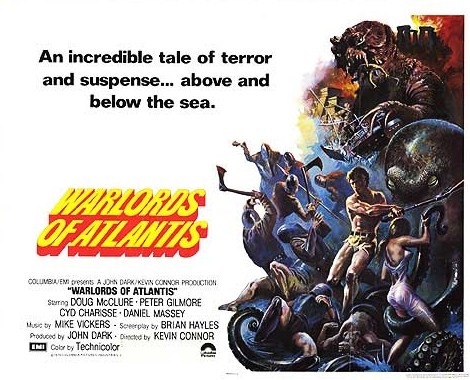
When I first saw the trailer for 'Warlords Of Atlantis', I remember thinking 'well, that looks like the greatest film of all time'. It's not quite that good, but it is energetic, fast moving and action packed, especially as, every fifteen minutes or so, there's a rubber monster attack.
Sucking his belly in, in Doug McClure stars as a Victorian engineer who is unknowingly on a trip to discover Atlantis. After being lost since the dawn of time, you'd think that finding the sunken city would be a tall order but, nope, within about ten minutes Doug, scientist / archaeologist Peter Gilmore and the rest of the raggle taggle scum bag crew have been plucked from their boat by an enormous octopus and dragged down to a land beneath the sea where giant, angry mutated animals roam the land and all the men have weirdo avant garde pie dish fringes. It's a funny place, especially when the Atlanteans reveal that they came from Mars and, finding the people of Earth 'retarded' (cheers) have been pulling the strings for our species since pre-history.
Their next goal as 'the master race' is progressing to a world of pure science - and total obedience - and, to illustrate what it might be like, they mind project pictures of Hitler addressing a Nazi rally. Having taken some time and trouble to get there, our intrepid adventurers now can't wait to get the hell away, especially as, if they stay much longer, they will be fitted with gills and forced to join the Atlanteans enormous slave army. Cue gunplay, high dives and a load of plastic fish that leap out of the water to rather ineffectually nip at parts of their fleeing bodies.
A great mix of cheapo action, high camp and Boys Own, 'Warlords' may not actually be the greatest film of all time, but it's a good laugh and utterly unpretentious, and the rubber monsters are fantastically rubbery.
Here's that trailer. It's not exactly how I remember it!
Saturday, 19 January 2013
Milton!
The formidable (and familiarly attired) Mr. Milton Reid turns up in 'Terror', playing a bouncer at a bizarre club where the main attraction is a stripping whip wielding punkette. When the customer get out of long, Milton attacks, neutralises and frogmarches their sleazy arses out. No lines, but plenty of action.
One Step Beyond Horror
‘Terror’ is absolutely brilliant from start to finish. Although there is a plot (something about a foxy witches curse), it mainly concerns itself with introducing (occasionally attractive) people before almost immediately putting them in perilous situations, racking up the tension with horror signifiers familiar from nightmares and other horror films and then summarily disposing of them in inventive, gruesome and bloody ways.
What most of them have to do with the curse is anyone’s guess, but that doesn’t matter. What does matter is that they die: beheaded by falling glass, smashed on the head by a falling spotlight that then catches fire, garrotted and then impaled on some railings. Most of all, there’s a whole lot of stabbing going on, and in really painful places, like the foot, and the crotch, and the mouth. I don’t suppose there is a nice place to get stabbed, but these attacks look particularly ‘ouch-y’ (if that is a word), and you can imagine contemporary audiences cringing as the blade plunges in.
Ostensibly a straightforward slasher, you keep expecting a ‘Scooby Doo’ dénouement where the killer is revealed - until the film climaxes in a full on supernatural assault in which that pesky, foxy witch turns up and wreaks her bloody final revenge which reminded me of ’Suspira’ on a shoestring budget, lots of dry ice and a wind machine.
Extremely enjoyable, and it features Milton Reid in a supporting role! It’s a classic, and the sort of film this blog is all about.
Friday, 18 January 2013
Friday, 4 January 2013
F*** Me, It's Freddie!

FMIF as runaway mob book keeper Dobson in a 1978 episode of 'Hazell' called 'Hazell Settles The Accounts'.
Friday, 2 November 2012
Creator Of Catastrophe
'The Medusa Touch' is a hilarious film about a sociopath who, unfortunately for the world, has limitless psychic powers. John Marlar (Richard Burton, awful) is a hugely bitter and angry person with a nasty habit of righting petty wrongs against him by using his mad telekinesis skills. He knocks his parents off a cliff with a runaway car, burns his school to the ground because he gets detention and, when he grows up, graduates to messing up space missions, crashing planes into tower blocks and making rubber rocks fall on people. Even when he has his head caved in with a bust of Napoleon he keeps going. Can anyone stop him? No. No, they can't. Even when clinically dead he blows up Windscale power station. He really is 'Le Grand Menace', as the French would have it. The Italians wouldn't even hang around long enough to give him a name.
The film is a real kedgeree of slumming talent - Lee Remick and the almost unintelligible Lino Ventura have the biggest supporting roles, and loads of other venerables pop up for a couple of scenes, including Harry Andrews, Norman Bird, Gordon Jackson, Jeremy Brett, Alan Badel, Michael Hordern, Robert Flemyng and Derek Jacobi. The star, of course, is Burton. Looking shorter, iller and older than ever, Burton prowls and scowls around in a brown cardigan, using his incredible voice to stretch out every syllable of the over-written dialogue he gets to spout. In a line that must have caused several film producers and directors to shake their heads ruefully, Burton declaims 'I am the man with the power to create catastrophe' - too fucking right, mate.
There is a chance that Osama Bin Laden may have watched this film and got the idea for 9/11, which is rather chilling - either that or he was inspired by that episode of 'Only Fools & Horses' where Del Boy installs a satellite dish stolen from Gatwick Airport and a 747 nearly crashes into Nelson Mandela House.
Subscribe to:
Posts (Atom)
.avi_snapshot_24.11_%5B2013.10.09_00.08.29%5D.jpg)