Showing posts with label Crime. Show all posts

Sunday, 12 July 2015

Christ Almighty


Art therapy is an essential part of prison for those serving long sentences: they've got to do something, after all, and smearing a load of paint all over a canvas can be cathartic.

Ronnie Kray was a keen amateur artist, and his paintings (not all of which are as good as his 'Crucifixion' above) now sell for several thousand pounds each. Good news, Ronnie, wherever you are: people are still fucking mugs when it comes to your tawdry legend.

A tip of the cap to  Jonny Trunk who originally posted this on Instagram and made me aware of it. Now I can't think about anything else, so, yeah, thanks a lot.

Saturday, 4 July 2015

F*** Me, It's Freddie!


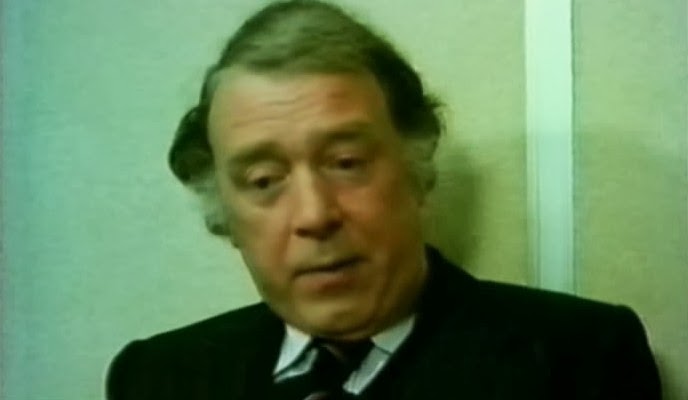
FMIF as Harry Field's Dad in 'Who Killed Harry Field?', a 1991 episode of 'Inspector Morse'. If you're wondering who did kill Harry Field, you'll have to watch the show, but, believe me, he definitely had it coming.  Freddie gives a great performance, by the way, but then that's Freddie's stock in trade, isn't it? He's a great hero of mine, and it feels good to be paying tribute to him again.

Monday, 30 June 2014

Valerie Leon, Kidnapper


Lovely Valerie Leon is all smiles as she pulls her Jag alongside a young girl on a bike. 'I've got a note from your Mum' she says. Taken in, the young girl stops pedalling only for Valerie to grab her while that bloke who used to be in Emmerdale puts a bag on her head and bundles her into the back of the motor. Valerie! Really? Has it come to this? Kid-kidnap? 

From a 1982 episode of odd (but very popular - it ran for four years and five series) crime show 'Strangers' called 'A Swift & Evil Rozzer'.

Saturday, 15 March 2014

F*** Me, It's Freddie!


FMIF as Detective Superintendent Clegg in a 1977 episode of testosterone and bullshit fuelled Patrick Mower vehicle 'Target'. His character is less than impressed to find out that Hackett (Mower) has been using his abnormally flared nostrils to sniff around Clegg's attractive daughter (Pamela Stephenson) and decides to take action. 


Freddie being Freddie, however, he manages to fit in a cup of tea before nailing Hackett's balls to the station wall.

Saturday, 22 February 2014

Don't Get Mad, Get Murderous


I don’t know about you, but I tend to judge revolutionary groups by just how much mayhem they cause. I’m not condoning it, but, if you really feel strongly about something, and you can’t settle it by democratic means, you should almost certainly leave a trail of blown up cars, robbed banks, assassinated politicians and burned out embassies in your wake.

Britain’s own The Angry Brigade took a gentler approach, trying to avoid hurting anyone if possible but, ultimately, they proved to be utterly ineffectual and got caught and imprisoned, so it was not a massively successful policy. I’m glad that they didn’t kill anybody, of course, but they might have got further if they had.

So what were they so angry about? Well,  is was all about that bloody System that people often rail about, the capitalist world that, in their eyes, grinds people down and reduces them as human beings. They hoped that by sending a few letter bombs and machine gunning some empty embassies they would incite the working man to rise up and violently revolt against their oppressors. Typical middle class radicals, really: banging on about freeing the proletariat but expecting them to do all the dirty work and the killing and dying while the instigators talk about who’ll be in charge of what in the new order.


Hilary and Anna. Hilary is on the far left , Anna is too.  
In 1972, ‘World In Action’ interviewed two out on bail Brigade members, Hilary Crick and Anna Mendelson. They don’t have much to say for themselves (Hilary is particularly, almost smugly, uncommunicative), and refuse (or are unable to) present a coherent view of events, or even something approaching a defence. Anna tries, but generally drifts off the point very quickly. That said, it must be remembered that these are two people in their early twenties who are under enormous strain and are each facing up to 15 years in prison, so their reluctance to incriminate themselves, and their inability to think straight can be forgiven, especially it is not thought that they were major players in the group.

Perhaps the final word should go to Jim Prescott, the only working class member of the group, a man who was prepared to kill and maim for his cause, but wasn’t allowed to and spent 10 years of his life in maximum security prisons anyway: ‘I realised that I was the one who was angry and the others were more like the Slightly Cross Brigade’.

What a very British revolution.

Wednesday, 25 September 2013

Oddments


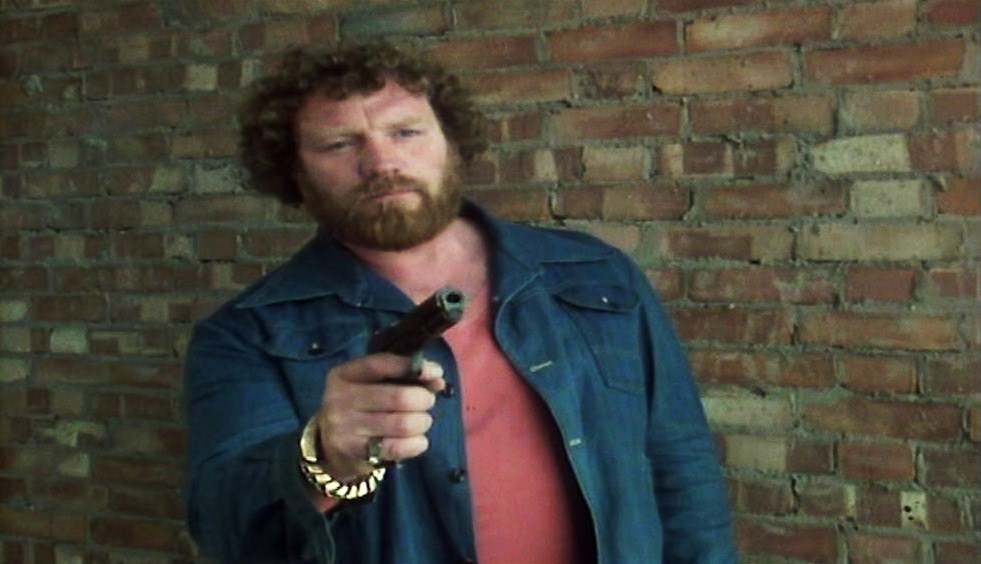
Perennial heavy Pat Roach gets heavy in 'Gangsters', and I'm not just talking about his jewellery.

Gangsters: The Bottom Five

As a final 'Gangsters' note, I just wanted to revisit the bit about the ‘abysmal’ acting. I can’t think of another show that has such a poor cast. I’m not sure if there was a dearth of black and Chinese and Asian actors around at the time, but the ones they have (with the exception of Sayeed Jeffrey) are terrible, and elaborate, overwritten dialogue plus unconvincing performances / mangled diction leads to a number of strange, stilted, uncomfortable scenes that do nothing apart from highlight that it’s all a big panto. Perhaps given the show’s experimental leanings this was deliberate, but either way it makes for a slightly awkward and jarring experience.

Anyway, in reverse order, here, in my opinion, are the five worst actors.


Maurice had a long career as an actor, latterly appearing in 'Howards Way'. He was always pretty wooden, but here he has to keep it all together as the star and he starts creaking as soon as he's asked to convey anything out of the ordinary. One of his signature bad acting traits is a soundless, mirthless laugh, and he uses it a lot here and it really gets on your nerves because because it's so poorly executed and incredibly fake.   


This is writer Philip Martin. He can obviously act (he played the villain in the original play very well), but his second series impersonation of W.C Fields is funny for approximately two minutes and then just seems staggeringly self-indulgent, especially when he can't quite keep up the pretence in key scenes.


Familiar to British audiences in both Chinese and Japanese roles, Lee always seems fast asleep. When he speaks, you can neither hear nor understand him, and his face doesn't form any kind of expression, so you're fucked if you're trying to follow the plot.


Aside from the fact that we share a first name, Mr. Satvendar does very little for me apart from to annoy. Shrill, slow to react, fond of rolling his eyes and almost forgetting his lines, Paul adds insult to injury by suffixing almost every sentence with a high-pitched hollow giggle and killing virtually every scene he's in stone dead. Awful.


This fellow is just terrible. He can't even walk around convincingly and his laugh (bit of a  recurring motif - I often find you can judge an actor by how they laugh and cry) is a thing of cringing terror. Luckily, his character is written as something of a joke (he has a ridiculous hat and keeps quoting from gangster films) and he gets knocked off pretty quick so it's not like he's given much to do - but what he does do is SHIT.

Who's your favourite terrible actor? And your least favourite? And what's the difference? 

Tuesday, 24 September 2013

Gangsters 2


Series two of 'Gangsters' followed three years later and goes off the rails almost immediately by introducing the Chinese Triads as a new adversary for the increasingly weary looking Kline. The Triads here are ridiculous, inscrutable stereotypes that owe a lot to Fu Manchu, but this seems deliberate, as this series seem intent on examing popular cliché and subverting the idea of the crime show. This also manifests itself by some bizarre fantasy interludes, an intermittent voice over in which the writer of the show (Phillip Martin) dictates instructions to a typist and Martin later appearing as a hit man who, for cover, impersonates W.C Fields (badly) all the time. This time around, the pretty decent theme tune has turned into a pretty awful theme song.


Clever clever, occasionally infuriating, totally self-indulgent, the series ends with one of the main characters simply saying ‘well, that’s that’ and walking off set followed by the writer throwing his script into the air. It’s not a completely satisfying show in any of its forms, but it is a great example of a time when the BBC had much more faith in its creative people, and was fully prepared to fund their stupid, bizarre, brilliant ideas, as long as at least a dozen people watched it. Them was the days.

Monday, 23 September 2013

Gangsters


'Gangsters’ is a weird show that, over time got weirder and weirder. Starting off as a ‘Play For Today’ before becoming two (very different) series, it is ostensibly about the murky world of organised crime in Birmingham, but also works as a treatise on race, society and the nature and conventions of drama itself. If that sounds heavy, don’t worry, it does it all in a tongue in cheek, often bizarre way. Oh, and a lot of the acting is abysmal.

 Maurice Colbourne plays John Kline, a former SAS man who is the archetypal tough, good man in a rough, bad situation, inexorably caught between rival underworld groups that are characterised by both their particular line in crime and their ethnicity. There are the Asian gangsters, who specialise in human traffic, illegal immigration and extortion; black gangsters who concentrate on drugs and prostitution and, over-seeing the whole bun fight, there are white gangsters, who sit back and take the lion’s share of the profits. The initial play was straightforward enough, a quirky but basically conventional drama that, apart from the racial diversity, and Brummie setting, could have starred Jimmy Cagney.


The two series that followed, however, go to strange places, eventually ending up somewhere between post-modernism and disappearing up its own exhaust pipe. In Series One, Kline battles to keep a nightclub open, keep the Law happy and play opposing criminal factions off against each other. He also falls in love with a posh junkie and part time prostitute. It’s far from conventional, but has structure and an element of realism, albeit a reality that could quite easily be imagined. Heavily stylised, the characters are many and mad as hatters, a multi-racial rainbow of thugs, twisters, bullies, bastards and undercover Pakistanis.

‘Gangsters’, in all its incarnations, is, like so many flawed things, absolutely fascinating, and far more interesting retrospectively than any number of tighter, tauter, straight crime dramas. Yes, it can get on your nerves, but it provokes a reaction, and that is assuredly a very good thing.


Saturday, 27 July 2013

The Long Goodbye


If you want to see really good screen acting, just watch the last couple of minutes of 'The Long Good Friday' and watch Hoskins go through a dozen emotions just using his massive face and expressive eyes. Subtle, believable, you can read his frantic jumble of thoughts so well that it doesn't need anything apart from a big close up - the moving picture that says a thousand words. The car journey from hell - to hell.    

Who Lit The Fuse?


'The Long Good Friday' takes two bete noirs of the seventies - gangsters and the IRA - and makes them fight, like 'Alien Vs. Predator' with worse teeth. it's a superb film: lean, savage, surprising - and the ending is one of the most unnerving in British cinema.

Bob Hoskins plays Harold Shand, a pugnacious East End crook who, having risen to the top by killing all of his opponents, is now looking to consolidate his position by doing a deal with the Mafia to develop what is now known as Docklands, just in time, he hopes, for Britain to host the 1988 Olympics. Without Shand's knowledge, a few of his mob have (rather unwisely) pissed off the Irish Republican Army, who then go after Shand and his boys with all the knives, guns, bombs and masonry nails they have at their disposal.

A film rich in dialogue, atmosphere and performances, 'The Long Good Friday' packs about three hours of story into just over an hour and a half and, like all the best tragedies, ends up with more or less everybody dead, lost or facing disaster or, in Harold's case, a mix of all three, as we never find out exactly what happens to him, although I think its safe to assume the very worst.

Perhaps the benchmark for the British gangster genre, how can you not love a film where Belloq from 'Raiders Of The Lost Ark' gets knifed trying to pick up Pierce Brosnan? Or where Denzil from 'Only Fools & Horses' gets his bare arse slashed with a machete? Or, best of all, where Charlie from 'Casualty' is stabbed repeatedly in the jugular vein with a broken bottle? All in all, it's a pretty stabby sort of film (although there are also shootings and blowing ups): brutal, brilliant, British.

The Long Good Friday