Showing posts with label Nigel Kneale. Show all posts

Friday, 13 September 2013

Dreaded Man-Beast Of Tibet


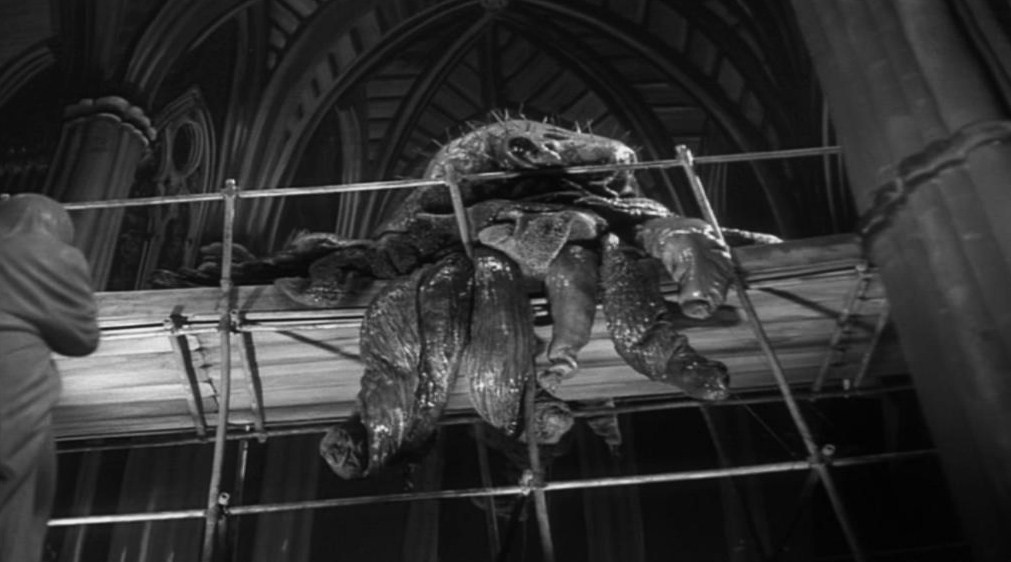
Regular readers will know that we love Nigel Kneale on The Island. ‘The Abominable Snowman’ is not one of his best known works, but it is an excellent example of Kneale’s brilliance, his compassion and, most of all, his unerring ability to turn a stock dramatic situation completely on its head.

Originally made as ‘The Creature’ for TV with Stanley Baker, Hammer eagerly snapped up the story as a counterpoint to their hugely successful ‘Quatermass’ adaptations. It stars Peter Cushing and Forrest Tucker as two men both in search of the Yeti, but with completely different motives: Cushing, of course, wants to make contact out of personal and professional curiosity, to study the creature from a scientific point of view and further man’s understanding of the world he lives in; Tucker wants money and glory, and doesn’t care how many big footed snow monsters he has to kill to get it.

The climax of the film, in which a concussed Cushing ‘meets’ the Yeti in their home environment, has a sense of subtle satisfaction for the fair minded. The creatures remain in the shadows, half-glimpsed, retaining their mystery. Most importantly, they clearly think that mankind is pretty abominable and they are simply biding their time waiting for us to blow each other up once and for all. It’s a wonderfully gentle ending to an intelligent and well-made film.

I also like the music, which rips off Ralph Vaughan-Williams marvellous score for ‘Scott Of The Antarctic’ extremely well, something RVW did himself for his seventh symphony.

Nigel Kneale, Hammer, Stanley Baker, Peter Cushing and Ralph Vaughan Williams all in one post? I spoil you, I really do.

The Abominable Snowman


Saturday, 12 January 2013

Enemy From Space


Two years after ‘The Quatermass Xperiment’, Brian Donelevy was back as the nutty professor in ‘Quatermass 2’ (I have wondered if this film and the TV version that preceded it are the first examples of numbered sequels, but it’s not like I’ve looked into it or anything).  Once again, Quatermass is battling an alien invasion, this time a methane breathing mass of micro-organisms who have been coming to Earth in artificial meteor showers, latching onto human hosts and getting the resulting zombies, some of whom are in positions of authority, to do stuff for them, including building a massive, top secret base out in the country.
Shot mostly on location, the film benefits from filming at two fantastic sites: the new town of Hemel Hempstead, still under construction (more here) and the huge but lightly manned Shell refinery at Stanford-le-Hope in Essex (the facility was largely automated, which adds to the eerie atmosphere). It is at the refinery where the bulk of the horror takes place: an MP dies after snooping around a storage tank and being covered in a horrible, hot, corrosive black slime; men are murdered and their bodies shoved into pipes to stop Quatermass gassing the aliens; the metal domes are not full of synthetic food (the cover story), but with millions of individual alien life forms clinging together to make a pulsating, undulating giant pile of greasy, toxic life.  Best of all are the silent, scarred guards – mindless enforcers and killers for an alien hive mind. They are cool.
Full of conspiracy and unease, ‘Quatermass 2’ is a superbly paranoid film, brilliantly creating a world where nothing is as it seems and all the misgivings the individual has about big business, corporate secrets and government collusion turn out to be true, and the implications far worse than anyone (except perhaps David Icke) could imagine.
Donlevy is noticeably less shouty as Quatermass this time around, although he still truncates his sentences and has a fairly obvious stand in for scenes that require rapid movement. He is ably supported by a cast of smooth British character actors, including the unflappable John Longden, the suave William Franklyn and a bequiffed Bryan Forbes. Sid James is in it too, playing a drunken, wide boy journalist who dies a hero.
The script was adapted from the original teleplay by Nigel Kneale himself, and condenses three hours of TV into a tidy hour and twenty five. It’s a classic, and a huge favourite of mine.  

Quatermass 2


Friday, 11 January 2013

No Terror Ever Like...


Hammer’s 1955 film adaptation of Nigel Kneale’s ground breaking ‘The Quatermass Experiment’* perhaps inevitably loses some of the subtlety and complexity of the much longer TV series, but it makes up for it in sheer propulsive energy, and in the way it uses documentary film devices to make science fiction appear to be science fact.

When the first manned rocket into space (British, of course) breaks contact with base for several days, it is assumed to have been lost until it suddenly reappears and crashes into a field. The rocket is intact, but minus two out of three astronauts, who seem to have vanished, leaving only their empty suits behind. The third man (the unforgettably named Victor Caroon) is in a catatonic state, and who can blame him, because Victor isn’t really Victor anymore as the rocket was infiltrated by a drifting parasitic space bug which has largely conquered Caroon, completely absorbed his two colleagues and now intends to take over the world. It’s a solid gold concept, and the film conveys the horror and uncanny threat of it superbly.

Shot largely in a cinema verite style, it’s gritty, actual approach lends a sense of genuine unease, especially when the mutating Caroon is stalking the bombsites and back yards of a very recognisable London, or sucking the animals at the zoo dry to feed the invaders insatiable appetite.

As Caroon, Richard Wordsworth gives a quite amazing performance, his long, bony face wordlessly expressing that the true tragedy of the situation is not that Caroon has disappeared, but that a part of him is still in there, completely unable to stop his absorption into something foul and alien and slimy but desperate to try. There is a scene where Caroon breaks into a Chemist’s shop and, horribly aware of what is happening to him,tries to mix the necessary poisonous elements needed to kill himself but, overcome by the alien forces within, murders and absorbs the pharmacist instead. The original ending of the TV series played on this awful concept, with the powers that be appealing to the human beings now within the alien to destroy themselves – and it – in order to save the world. In the film, however, they simply electrocute it – ZAP! – and the rubber prop catches fire and falls to bits, a far less satisfactory but perhaps more obviously ‘thrilling’ finale (it's definitely more shocking, if you'll forgive the pun. Oh, you won't? Fair enough, it was pretty poor).

Professor Quatermass, the progenitor of the scheme, is played by Brian Donlevy. Donlevy has long been a figure of ridicule for his brusque, barking, waddling performance, as well as for apparently being hammered in pretty much every scene. I don’t think he’s that bad, but he simply doesn’t convince as a visionary scientist – he doesn’t think or understand enough, and always seems to be a beat behind, reacting to rather than anticipating issues. He’s also an American, which makes sense in terms of contemporary funding / box office opportunities, but now seems like a lost opportunity for a generation of home grown character actors. Shame, especially as, ironically, Donlevy was actually born in Northern Ireland.

For all the quibbles, though, it remains a great film - but then, with the sort of source material Kneale provided, greatness is no more than you would expect. What would proper film critics call it? Oh yeah, a truly seminal work.

*Hammer’s version was renamed ‘The Quatermass X-periment’ to make the most of its ‘X certificate’ status. Brilliantly predictable, those Hammer types, shameless masters of self-promotion. 

The Quatermass X-Periment


Monday, 12 November 2012

Beasts: The Dummy


‘The Dummy’ is the only rubber beast of Nigel Kneale's series, a character in a popular and endless series of  low budget horror films. Inside the grotesque costume is a man (Bernard Horsfall) who has come to identify more with the monstrous Dummy than the people around him, most of whom use him ruthlessly for their own ends.

Alcoholic, tired, hot, trapped, the actor’s life is falling messily apart and the final kick in the teeth comes when his wife (sexy Patricia Maynard) leaves him for his co-star, an absolute grade one twatpot played with aplomb by smooth, supercillious, infuriatingly smug Simon Oates. Faced with this latest humiliation, he does what any drunk and disintergrating bloke in a monster suit would do and goes on a kill crazy rampage…

Well written (of course), well acted, ‘The Dummy’ is a very talky piece of drama, but that’s not a bad thing: the characters have a lot to say. Kneale may very well be having a pop at Hammer in the basic elements of the set up, but the bulk of the drama isn’t really about horror, or at, least, not the supernatural – all the nasty things here are painfully human, the most horrible horror of all.  

Monday, 6 August 2012

Beasts: What Big Eyes


‘What Big Eyes’ was the penultimate episode of the superb Nigel Kneale written series ‘Beasts’, and was originally shown on 13th November, 1976.

A young Michael Kitchen plays an idealistic RSPCA inspector who discovers a mad scientist (Patrick Magee) who conducts inhumane experiments on wolves, believing them to be mankind’s true ancestors. The scientist’s goal is to become a lycanthrope and, although his work will eventually kill him, he is convinced that, on death, he will turn into a werewolf.

A slow burning episode with a subtle but subliminally shocking denouement, ‘What Big Eyes’ is perhaps the lowest key episode of the series, a subtle psychological drama totally dominated by a wild eyed performance from the reliably out there Patrick Magee. Magee was one of the most incredibly intense actors to ever grace stage and screen, his performances are often almost incoherently angry. He died from a massive heart attack at the age of 60: I’m surprised his ticker actually held out that long.

Wednesday, 25 April 2012

Beasts: Baby


'Baby' is the fourth episode of Nigel Kneale's 1976 ITV series 'Beasts'. I also think it's the best.

When a young married couple move into an old cottage they are surprised to find a sealed pot in the chimney breast containing, well, no-one can really tell, not even the husband who is a vet. They both agree it's pretty horrible, though, especially the pregnant wife, who feels it is something unspeakably evil that must be destroyed.

Local yokels working on the cottage fill in the details: it's a witches familiar, a nasty creature conjured up by black magic - and it needs getting rid of, fast, before its owner comes to collect it...

The creepiest episode in the series, it does what Kneale does best: slowly and surely building tension and foreboding before providing a terrifying and chilling denouement. The first time I saw this I actually had to turn the light on before I went to bed. Luckily, when I did, there was nothing being suckled in the corner of the room. 

Tuesday, 14 February 2012

Beasts: Buddyboy


'Buddyboy', the third episode in Nigel Kneale's 1976 ITV series 'Beasts' is probably the least believable of the series, and, as its story concerns the vengeful ghost of a performing dolphin, it's possibly the silliest as well. Kneale's unbelievable and silly is still streets ahead of others logical and heavy, however, and, as usual, he's absolutely right - any dolphin dragged from the wide open sea and forced to do tricks in a tiny pool in a shitty part of London would be pretty ticked off, even beyond the grave.

Martin Shaw plays Dave, a bubble permed porn magnate in the making who wants the abandoned dolphinarium as the latest outpost in his burgeoning smut empire; Pamela Moiseiwitsch (great name) is the strange young woman seemingly possessed by the titular mammal.