Monday, 25 March 2013

The Spectre Of Hauntology


Ghost Box Records, 2004 – 2009:
A Personal Appreciation

For a long time, from early childhood up until about ten years ago, in fact, I had a recurring dream about the Somerset town of Sedgemoor. In the dream, I simply walked around familiarising myself with the topography of the place: the pub, the cinema (which only showed French films, no subtitles), the zoo, the observatory. I always felt anxious, uneasy, however: as if I was looking for something that was always in the next street, around the next corner - and confused, as if I’d been there before but forgotten almost everything (can you have déjà vu in a dream? It seems like a bit of a neurological cluster fuck.). The dream was unsettling but intriguing at the same time. I always looked forward to the next instalment. I’d never been to Sedgemoor, of course, indeed, I couldn’t have been to Sedgemoor, as it doesn’t exist as a town, being instead an administrative region (which, interestingly, contains the village of Shapwick*).


Sedgemoor Today.

Fantasy Village Not Pictured.

It’s origin was easy explained in that I used to obsessively read my Dad’s ‘AA Guide to Great Britain’ on car journeys and had seen it mentioned there with regard to the bloody Civil War battle that took place in the area in 1685. My Sedgemoor was a combination of pictures in the book, things I had seen on my travels and a distorted, reconfigured version of Colchester, the town I was born in, with its Iron Age earthworks, Roman wall, Norman castle, Medieval abbey, Tudor houses, Civil War bullet holes, Victorian Town Hall and 1960’s brutalist car parks and tax office.


The Castle.

The New Arts Centre.

Balkerne Gate.

North Hill.

As I got older, the dream continued, but the location gradually moved from the town centre to the outskirts, then to the moors and, eventually, to a high and wind-blown vantage point above another, larger and more industrialised town. The dream would end when it started to get dark, and the lights would start to come on in the conurbation below. This dream was less intriguing, and a lot less fun as it seemed to be telling me something slightly unpalatable, and I was glad when it stopped.

So what has this to do with Ghost Box? Well, I suppose the recurring dream (and a myriad of other things) made me inordinately receptive to the hauntology movement (if you can call it a movement -  it might also be described as a slow, collective realisation) and I immediately dedicated myself to the cause.

Let’s be clear: I’m not a theorist or a philosopher or a commentator, and my interest was less in the science that underpinned it (something about Derrida, Marx, postmodernism), but in the way it grouped together the real and the imagined, not distinguishing between the two complementary, but contradictory states, but instead creating a third way: a collision of fact and figment filtered through a series of complicated and incomplete emotional responses. That’s a lot of verbiage but, in effect, hauntology took my dream of Sedgemoor (and all the other fragmented pieces of the ever present past which I couldn’t get out of my head) and gave them a context – a framework - and, just as importantly, through Ghost Box, a soundtrack.

Since 2004, my life has been enriched by the existence of Belbury Poly, The Advisory Circle and The Focus Group, the original Ghost Box dream team. Their early recordings, beautifully designed and on homemade CDR’s, are masterpieces of time and space warped dream pop: wonderful electronic collages of post-war British life and culture, but seen fleetingly and incompletely, as from the corner of the eye, or through a prism of refracted light.

Ghost Box music perfectly encapsulates the experience of my recurring dream: the always moving, never arriving; the unfamiliar familiar. This music doesn't get worn out, you can't know every note by heart. Instead, it shifts eerily from moment to moment, presenting a different face at each listen.  The artists on the label have both distinct and indistinct personalities: they have their own style, their own sound, they are unique - but they make Ghost Box music - melodic, but odd and abstracted; easy listening avant garde.

Belbury Poly are led by Jim Jupp. The first out of the blocks, their 5" CD EP was the premier Ghost Box release and set the tone by making library music that sounded as if it had been captured from VHS tapes of old Anglia TV documentaries. There’s something slightly despicable about the term ‘imaginary soundtrack’, given how many times the idea has been abused, but Belbury Poly work it in an interesting way: you can see the programmes in your head, but the music is the illusion. Like a Rorschach ink blot test ‘Osprey’ is pretty specific for something so nebulous: it’s the sound of a ‘Survival Special’ broadcast to no-one in the aftermath of a nuclear war. It also reminds me of The United States Of America track 'Love Song For The Dead Che', which is about as good as it gets for me.


The Focus Group are chief designer Julian House's concern. The most uncompromising on the label, their music sounds like a photo album of people you don't know in familiar settings (or, conversely, people you do know in places they couldn't possibly be). Their albums are pin boards of sonic invention, a jittery, febrile jumble of ideas and daydreams. I think they’re probably my favourite GB artist. Here's 'Hey, Let Loose Your Love', a marvellous melding of a sample from Scrabble high score John Yvisaker with a ton of general and assorted aural weirdness. Nicely apropos visuals here too, taken from 'Bizarre: Secrets Of Sex', which I must get back to at some point.


The Advisory Circle are led by Jon Brooks. Their output seems the most musically conventional at time, but, as Brooks has said:

 ‘everything’s fine, but there’s something not quite right about it’.

Brooks is responsible for the first Ghost Box concept album***, ‘Other Channels’, a record about a housewife who can only get through the day by sitting in front of the telly stupefied by a handful of Mogadon. 'Fire, Damp and Air' is simply a beautiful and evocative piece of music that conjures up the best in soundtrack music (Barry, Morricone, Marc Wilkinson's amazing score for 'Blood On Satans Claw') an adds additional unease, the off kilter, the off balance, the 'not quite right'.
.


The dates 2004 to 2009 in the title of this post do not refer to the lifespan of the label, by the way. They are still here - and long may they be so. The dates aren’t indicative of my interest, either, I bought my last Ghost Box release in October 2012, i.e. when the last Ghost Box release came out. Instead, the dates, for me, mark the first phase of GB history, from their DIY beginnings to the magnificent album 'Broadcast and The Focus Group Investigate Witch Cults of the Radio Age’(not actually on Ghost Box, ironically, but Warp Records, the home of Broadcast – but this is a mere detail).

This album, with its shimmering and hallucinatory blend of folk, pop, electronics and horror soundtrack, seems to me to be the ‘Blonde On Blonde’ of Ghost Box records, i.e. the culmination of the five year evolution of a sound, a genetically perfect ‘best of breed’ where all the elements are perfectly balanced to create a definitive document. From here, Ghost Box changes, diversifies, spreads out, grows. But that’s another story, another post. Here’s a somewhat dazzling and disorienting trailer for the album which, if you haven’t already got it, is bound to make you want it.


As a postscript, in December 2011 I had to have an emergency operation and had to stay overnight in hospital. I only slept for a few hours that night but I had the dream again, the dream where I was above the town and it was getting dark. This time, however, there was an elephant and a circus tent and a sinister, black faced man in a red coat. When I woke up, I realised the sad, silly truth: my dream had been replaced forever by another fiction - my memory of the closing scene of the second series of ‘The League of Gentlemen’.

*   In 2012, Jon Brooks from The Advisory Circle released an album called ‘Shapwick’, a set of soundscapes inspired by his imaginary vision for a very real place.

** Ghost Box themselves are largely ambivalent about the term ‘hauntology’. I’m not particularly convinced by it myself but, to as I’ve said, it gives a single name to a complex concept. 

***In truth, all Ghost Box albums are concept albums.

Saturday, 23 March 2013

Above And Below The Sea


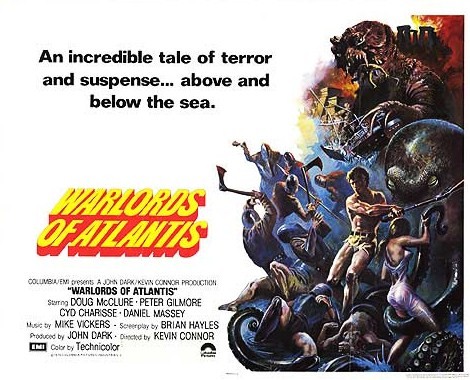
When I first saw the trailer for 'Warlords Of Atlantis', I remember thinking 'well, that looks like the greatest film of all time'. It's not quite that good, but it is energetic, fast moving and action packed, especially as, every fifteen minutes or so, there's a rubber monster attack.

Sucking his belly in, in Doug McClure stars as a Victorian engineer who is unknowingly on a trip to discover Atlantis. After being lost since the dawn of time, you'd think that finding the sunken city would be a tall order but, nope, within about ten minutes Doug, scientist / archaeologist Peter Gilmore and the rest of the raggle taggle scum  bag crew have been plucked from their boat by an enormous octopus and dragged down to a land beneath the sea where giant, angry mutated animals roam the land and all the men have weirdo avant garde pie dish fringes. It's a funny place, especially when the Atlanteans reveal that they came from Mars and, finding the people of Earth 'retarded' (cheers) have been pulling the strings for our species since pre-history.

Their next goal as 'the master race' is progressing to a world of pure science - and total obedience - and, to illustrate what it might be like, they mind project pictures of Hitler addressing a Nazi rally. Having taken some time and trouble to get there, our intrepid adventurers now can't wait to get the hell away, especially as, if they stay much longer, they will be fitted with gills and forced to join the Atlanteans enormous slave army. Cue gunplay, high dives and a load of plastic fish that leap out of the water to rather ineffectually nip at parts of their fleeing bodies.

A great mix of cheapo action, high camp and Boys Own, 'Warlords' may not actually be the greatest film of all time, but it's a good laugh and utterly unpretentious, and the rubber monsters are fantastically rubbery.

Here's that trailer. It's not exactly how I remember it!

Warlords Of Atlantis


Friday, 22 March 2013

The Adventure You Will Never Forget


‘The Land That Time Forgot’ is classic school holiday fodder, a rip-roaring adventure full of dinosaurs, spear chucking and volcanic explosions. This one even has a submarine which, I must admit, I always find a bit exciting. I love submarines.

Set during World War One and based on a book by pulp colossus Edgar Rice Burroughs, the action takes place on the mysterious island of Caprona, an uncharted place which, despite being near Antarctica, has a tropical climate. It also has a unique eco-system where pterodactyls rule the skies and stegosaurus’ are forever getting into scraps with tyrannosaurs. Chuck in some Neanderthal type people, some lost German sailors and Doug McClure at his most McClure-ish and you’ve got yourself one hell of a film – if you’re about eleven. Happily, that’s my mental age.

One of a number of films that Amicus produced aimed firmly at a younger audience, ‘The Land That Time Forgot’ is cheap, unpretentious fun – but not without imagination, perhaps even style. Pulp source material of a certain vintage often throws up something odd – some bizarre theory or pseudo-scientific viewpoint (usually insanely right wing) – and here it is hinted that the unusual properties of the island mean that its inhabitants evolve not over time but over distance, i.e. the further north people go, the more sophisticated they become. It’s pretty suspect (people from warmer climates are more primitive?) but it gives the narrative an edge of strangeness and mystery, which it needs. Man does not live by pterodactyl attack alone, you know.

The Land That Time Forgot


Wednesday, 20 March 2013

Milton!


Milton Reid makes a very brief appearance in the 1971 Jason King episode 'From Russia With Panache' and ends up getting beaten up by the flamboyant Mr. King and chucked down a lift shaft. Nice to see him in a costume, though, instead of that rather tired brown jerkin ensemble. He rounds off his somewhat nautical look here by tucking his trousers into a pair of knee high leather boots (not pictured). Milton is an inveterate trouser tucker, but he was born in India, so perhaps he was scared of snakes.

Speaking of Jason King / Peter Wyngarde, he's been absent from these pages for far too long. The place just isn't the same without him, so I'll have to do something about that, won't I?.    

Tuesday, 19 March 2013

Squeals


I have made a mix for you all. It has no theme, and is very basically some music I have been listening to sprinkled with the odd unrelated sample. I call it ‘You’re Not Alone’. And you’re not, you’re really not.


The track listing is as follows:

001 The John Barry Seven: Bees Knees / 002 Anthony Newley: Bee-Bom / 003 Jose James: Equinox / 004 Francois de Roubaix: Tempo / 005 Roger Roger: Roger Rhythm Number One / 006 The Pyramids: Out Of Limits / 007 Sounds Incorporated: Bullets / 008 The Welfare State and White Noise: Silence Is Requested / 009 Michael Garrick: Return of An Angel / 010 Jack Arel and Jean-Claude Petit: Psychedelic Portrait / 011 Ivor Cutler: Cockadoodledon't 
The accompanying image is from the 1970 Francois Truffaut film ‘L’enfant Sauvage’. I don’t just watch British horror and sci fi film and TV, you know. But I mostly do.

Monday, 18 March 2013

The Two Faces Of Evil


Hammer House of Horror is a series of much variety, particularly with regard to quality. ‘The Two Faces of Evil’, however, is an exceptional episode, not least because it is really scary.
Like all the best horror tales, ‘Two Faces Of Evil’ doesn’t mess about with exposition or, indeed, explanation. The ending is utterly inconclusive, but perfectly apt. What it does provide, however, is a world where something unearthly and terrifying is happening, and a nightmare of random violence, madness and death.


It begins with a cheery family unit (Martin and Janet Lewis and blond haired son, David) on their way to a holiday cottage in Buckinghamshire. During a sudden rainstorm they nearly hit a pedestrian, and then offer him a lift. Within seconds, the mysterious, silent man (dressed in a really creepy ensemble of bright yellow sou’wester and matching oilskins) attacks Martin, tearing at his face with his hand and, in particular, a single nasty, dirty pointed fingernail. Struggling for his life as Janet and David scream their heads off in the back, Martin flips the car over and everything goes black. 

Janet wakes up in that most sinister of locations, the Cottage Hospital, made all the more eerie by some interesting camera angles and shifty eyed staff. She’s alright, apart from a big bruise on her head, and David is unharmed. Martin, however, has undergone an emergency operation to remove some broken glass from his throat and is generally torn, scratched and battered (there's a particularly chilling scene where he raises himself up in bed and outstretches his bandaged hand in a gesture that is equal parts pitiful plea and evil monkey point. As he does so, blood slowly seeps through the bandage around his neck.) Nobody knows anything about the psychotic passenger - although, coincidentally, the authorities have found a corpse in the area that they have been unable to identify.


Janet finds that all of their luggage has been savagely ripped apart, and begins to have disjointed flashbacks to the immediate aftermath of the accident, seeing her husband fighting for his life (and theirs) against the frenzied onslaught of the passenger, who apparently lost a hand in the accident. 
Janet is asked if she can identify the corpse in the morgue and, although it is missing a hand, she cannot definitely say if it the body of their attacker although, bizarrely, it looks exactly like her husband.


Martin is discharged from the hospital and the family continue on to their holiday let. His throat is still bandaged, so he can’t speak, and he alternates between utter exhaustion and bouts of fury. One night, as he reaches to touch Janet's face, she notices he has a single nasty, dirty pointed fingernail. This Martin also has terrible teeth, in strict contrast to her 'real' husband’s pearly whites.


What follows is an increasingly frantic descent into the abyss, as Janet finds herself in a place that makes no sense and where everything she trusts and loves has becomes sinister and dangerous, including, eventually, her son, in an unforgettable moment that has haunted me for thirty odd years.


It is never explained why Martin has been ‘replaced’, or how. There's no quick tie up with some nonsense about aliens or doppelgangers or the compliant locals all being part of a coven. In actual fact, I don’t think there could be an adequate explanation, apart from the obvious answer that Janet is mad or concussed or dreaming, and everything that happens after the accident is a delusion, but I think that would be a cop out, and this is not a cop out sort of story – this is paranormal, primordial horror – urban myth, fairy tale, folk legend.     

One final note: in an apparently inexplicable story where a bizarrely dressed psycho stalks the land randomly ruining peoples lives, seemingly with the collusion of the authorities, is there possibly a clue to be had in the location?  


Sunday, 17 March 2013

It's A Small World


Modern Town Centre,
Model Village, Babbacombe,
Torquay,
Devon.


I love the message on this postcard, especially the very British way that even a child feels compelled to use the limited space he has to write about the weather even though he's seen The Banana Splits bus and is dying to tell his mate about it. I also like the two different spellings of 'Banana Splits', both wrong. Is it just me, though, or does the Red Arrows bit sound a little bullshitty? Like someone who tells you he once shagged one of Legs and Co, oh, yeah, and her out of Blondie.  

Saturday, 16 March 2013

The Equestrian Vortex


The film that Gilderoy (I forgot to mention, the Toby Jones character’s name is Gilderoy) is working on is a dark, witchy horror called ‘The Equestrian Vortex’. Its title sequence is brilliantly realised by ‘Focus Group’ man and design giant Julian House, with music from the wonderful, though sadly depleted, Broadcast. If it were any more hauntological, you’d be a ghost.