Showing posts with label Val Guest. Show all posts

Friday, 31 May 2013

The Unbelievable Becomes True


‘The Day The Earth Caught Fire’ is an apocalyptic sci fi classic from 1961. In it, US and Soviet nuclear testing has knocked the Earth out of orbit, and the planet is now moving closer and closer to the sun. The temperature has become unbearable, and food and water shortages have led to rationing, martial law and nihilistic trad jazz parties. The only way of stopping our inexorable journey towards immolation is to detonate yet more bombs and hope that the shock waves might move us somewhere else. At the end of the film, as the bombs go off, two headlines are prepared ‘Earth Saved’ and ‘Earth Doomed’, but we are not informed as to which is going to print*.
An excellent, methodical, believable film, ‘The Day The Earth Caught Fire’ is hugely dramatic and brilliantly executed, with some fantastic miniature work and a clever tinting effect which bookends the narrative, turning everything orange to emphasise the unbearable heat. It has a good cast, too, angry Edward Judd as a loose cannon newspaperman, Leo McKern as his crusty but avuncular Boss, and comely Janet Munro as Judd’s love interest. This is a sultry film in more ways than one, incidentally, with a frank ‘let’s do it, it’s the end of the world’ approach to sex and some semi-nudity from both Munro and Judd. Happily, McKern keeps his vest on.


The film is also notable for an early appearance from Sir Michael Caine, here seen directing traffic. We can't really see his face, but his voice is absolutely unmistakeable. I like Mike, I like Mike a lot.  

Intelligent, logical, frightening, this slice of Val Guest directed genius receives my highest recommendation. In fact, if I had three thumbs I’d stick them all up.
*The American distributors asked for the sound of bells to be superimposed over the end scenes, presumably to indicate that the world was saved, but this doesn’t spoil the ambiguity at all – had they never heard of a death knell?

The Day The Earth Caught Fire


Saturday, 12 January 2013

Enemy From Space


Two years after ‘The Quatermass Xperiment’, Brian Donelevy was back as the nutty professor in ‘Quatermass 2’ (I have wondered if this film and the TV version that preceded it are the first examples of numbered sequels, but it’s not like I’ve looked into it or anything).  Once again, Quatermass is battling an alien invasion, this time a methane breathing mass of micro-organisms who have been coming to Earth in artificial meteor showers, latching onto human hosts and getting the resulting zombies, some of whom are in positions of authority, to do stuff for them, including building a massive, top secret base out in the country.
Shot mostly on location, the film benefits from filming at two fantastic sites: the new town of Hemel Hempstead, still under construction (more here) and the huge but lightly manned Shell refinery at Stanford-le-Hope in Essex (the facility was largely automated, which adds to the eerie atmosphere). It is at the refinery where the bulk of the horror takes place: an MP dies after snooping around a storage tank and being covered in a horrible, hot, corrosive black slime; men are murdered and their bodies shoved into pipes to stop Quatermass gassing the aliens; the metal domes are not full of synthetic food (the cover story), but with millions of individual alien life forms clinging together to make a pulsating, undulating giant pile of greasy, toxic life.  Best of all are the silent, scarred guards – mindless enforcers and killers for an alien hive mind. They are cool.
Full of conspiracy and unease, ‘Quatermass 2’ is a superbly paranoid film, brilliantly creating a world where nothing is as it seems and all the misgivings the individual has about big business, corporate secrets and government collusion turn out to be true, and the implications far worse than anyone (except perhaps David Icke) could imagine.
Donlevy is noticeably less shouty as Quatermass this time around, although he still truncates his sentences and has a fairly obvious stand in for scenes that require rapid movement. He is ably supported by a cast of smooth British character actors, including the unflappable John Longden, the suave William Franklyn and a bequiffed Bryan Forbes. Sid James is in it too, playing a drunken, wide boy journalist who dies a hero.
The script was adapted from the original teleplay by Nigel Kneale himself, and condenses three hours of TV into a tidy hour and twenty five. It’s a classic, and a huge favourite of mine.  

Quatermass 2


Friday, 11 January 2013

No Terror Ever Like...


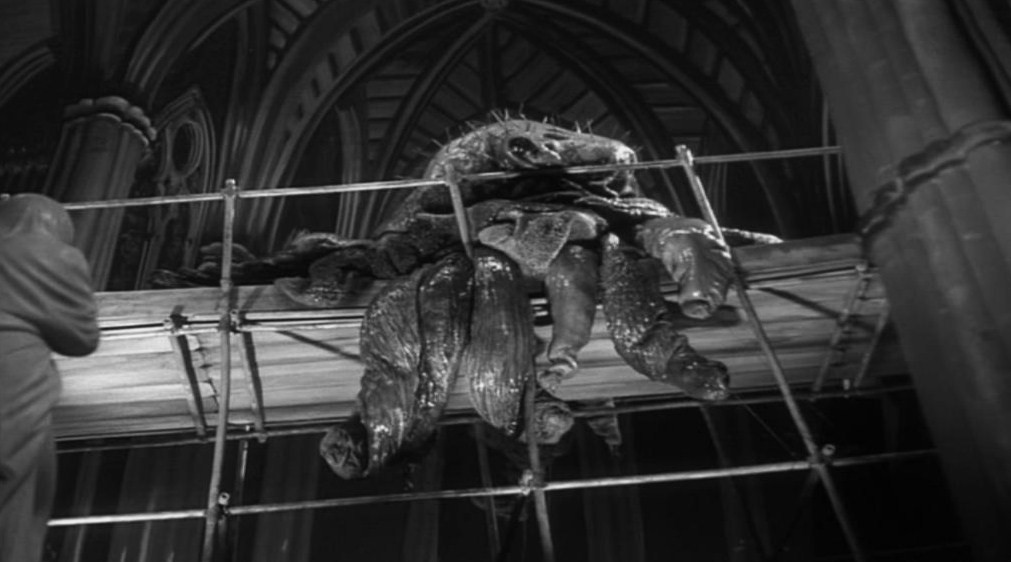
Hammer’s 1955 film adaptation of Nigel Kneale’s ground breaking ‘The Quatermass Experiment’* perhaps inevitably loses some of the subtlety and complexity of the much longer TV series, but it makes up for it in sheer propulsive energy, and in the way it uses documentary film devices to make science fiction appear to be science fact.

When the first manned rocket into space (British, of course) breaks contact with base for several days, it is assumed to have been lost until it suddenly reappears and crashes into a field. The rocket is intact, but minus two out of three astronauts, who seem to have vanished, leaving only their empty suits behind. The third man (the unforgettably named Victor Caroon) is in a catatonic state, and who can blame him, because Victor isn’t really Victor anymore as the rocket was infiltrated by a drifting parasitic space bug which has largely conquered Caroon, completely absorbed his two colleagues and now intends to take over the world. It’s a solid gold concept, and the film conveys the horror and uncanny threat of it superbly.

Shot largely in a cinema verite style, it’s gritty, actual approach lends a sense of genuine unease, especially when the mutating Caroon is stalking the bombsites and back yards of a very recognisable London, or sucking the animals at the zoo dry to feed the invaders insatiable appetite.

As Caroon, Richard Wordsworth gives a quite amazing performance, his long, bony face wordlessly expressing that the true tragedy of the situation is not that Caroon has disappeared, but that a part of him is still in there, completely unable to stop his absorption into something foul and alien and slimy but desperate to try. There is a scene where Caroon breaks into a Chemist’s shop and, horribly aware of what is happening to him,tries to mix the necessary poisonous elements needed to kill himself but, overcome by the alien forces within, murders and absorbs the pharmacist instead. The original ending of the TV series played on this awful concept, with the powers that be appealing to the human beings now within the alien to destroy themselves – and it – in order to save the world. In the film, however, they simply electrocute it – ZAP! – and the rubber prop catches fire and falls to bits, a far less satisfactory but perhaps more obviously ‘thrilling’ finale (it's definitely more shocking, if you'll forgive the pun. Oh, you won't? Fair enough, it was pretty poor).

Professor Quatermass, the progenitor of the scheme, is played by Brian Donlevy. Donlevy has long been a figure of ridicule for his brusque, barking, waddling performance, as well as for apparently being hammered in pretty much every scene. I don’t think he’s that bad, but he simply doesn’t convince as a visionary scientist – he doesn’t think or understand enough, and always seems to be a beat behind, reacting to rather than anticipating issues. He’s also an American, which makes sense in terms of contemporary funding / box office opportunities, but now seems like a lost opportunity for a generation of home grown character actors. Shame, especially as, ironically, Donlevy was actually born in Northern Ireland.

For all the quibbles, though, it remains a great film - but then, with the sort of source material Kneale provided, greatness is no more than you would expect. What would proper film critics call it? Oh yeah, a truly seminal work.

*Hammer’s version was renamed ‘The Quatermass X-periment’ to make the most of its ‘X certificate’ status. Brilliantly predictable, those Hammer types, shameless masters of self-promotion. 

The Quatermass X-Periment


Saturday, 15 September 2012

Diabolical


'Stop Me Before I Kill' is an effective psychological thriller about a racing driver called Alan Colby who, after a car crash, finds himself really pissed off all the time and compulsively wanting to strangle his new wife, Denise.As she is played by the gorgeous Diane Cilento this seems hard to take, especially as he also avoids all physical contact with her. The boy's a fool.

Whilst on a belated honeymoon in the south of France, a smooth gallic psychiatrist takes an interest in Alan's case, and, especially, in his wife. Can the slightly creepy doctors radical methods cure Alan, or will they kill Denise?

Intriguing to the last, the film is perhaps most notable for a very angry performance from Ronald Lewis, and a very sexy one from the former Mrs. Connery. Occasionally quite explicit for 1960 in terms of sex and gore, it manages to keep you guessing and entertained and slightly turned on, all at the same time. Quite an achievement.