Showing posts with label Quatermass. Show all posts

Saturday, 12 January 2013

Enemy From Space


Two years after ‘The Quatermass Xperiment’, Brian Donelevy was back as the nutty professor in ‘Quatermass 2’ (I have wondered if this film and the TV version that preceded it are the first examples of numbered sequels, but it’s not like I’ve looked into it or anything).  Once again, Quatermass is battling an alien invasion, this time a methane breathing mass of micro-organisms who have been coming to Earth in artificial meteor showers, latching onto human hosts and getting the resulting zombies, some of whom are in positions of authority, to do stuff for them, including building a massive, top secret base out in the country.
Shot mostly on location, the film benefits from filming at two fantastic sites: the new town of Hemel Hempstead, still under construction (more here) and the huge but lightly manned Shell refinery at Stanford-le-Hope in Essex (the facility was largely automated, which adds to the eerie atmosphere). It is at the refinery where the bulk of the horror takes place: an MP dies after snooping around a storage tank and being covered in a horrible, hot, corrosive black slime; men are murdered and their bodies shoved into pipes to stop Quatermass gassing the aliens; the metal domes are not full of synthetic food (the cover story), but with millions of individual alien life forms clinging together to make a pulsating, undulating giant pile of greasy, toxic life.  Best of all are the silent, scarred guards – mindless enforcers and killers for an alien hive mind. They are cool.
Full of conspiracy and unease, ‘Quatermass 2’ is a superbly paranoid film, brilliantly creating a world where nothing is as it seems and all the misgivings the individual has about big business, corporate secrets and government collusion turn out to be true, and the implications far worse than anyone (except perhaps David Icke) could imagine.
Donlevy is noticeably less shouty as Quatermass this time around, although he still truncates his sentences and has a fairly obvious stand in for scenes that require rapid movement. He is ably supported by a cast of smooth British character actors, including the unflappable John Longden, the suave William Franklyn and a bequiffed Bryan Forbes. Sid James is in it too, playing a drunken, wide boy journalist who dies a hero.
The script was adapted from the original teleplay by Nigel Kneale himself, and condenses three hours of TV into a tidy hour and twenty five. It’s a classic, and a huge favourite of mine.  

Quatermass 2


Friday, 11 January 2013

No Terror Ever Like...


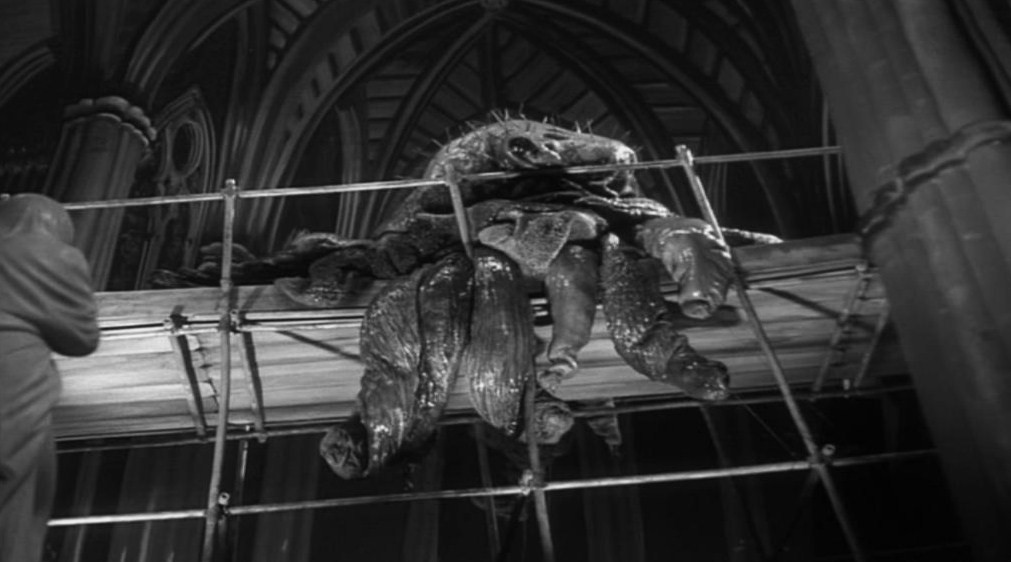
Hammer’s 1955 film adaptation of Nigel Kneale’s ground breaking ‘The Quatermass Experiment’* perhaps inevitably loses some of the subtlety and complexity of the much longer TV series, but it makes up for it in sheer propulsive energy, and in the way it uses documentary film devices to make science fiction appear to be science fact.

When the first manned rocket into space (British, of course) breaks contact with base for several days, it is assumed to have been lost until it suddenly reappears and crashes into a field. The rocket is intact, but minus two out of three astronauts, who seem to have vanished, leaving only their empty suits behind. The third man (the unforgettably named Victor Caroon) is in a catatonic state, and who can blame him, because Victor isn’t really Victor anymore as the rocket was infiltrated by a drifting parasitic space bug which has largely conquered Caroon, completely absorbed his two colleagues and now intends to take over the world. It’s a solid gold concept, and the film conveys the horror and uncanny threat of it superbly.

Shot largely in a cinema verite style, it’s gritty, actual approach lends a sense of genuine unease, especially when the mutating Caroon is stalking the bombsites and back yards of a very recognisable London, or sucking the animals at the zoo dry to feed the invaders insatiable appetite.

As Caroon, Richard Wordsworth gives a quite amazing performance, his long, bony face wordlessly expressing that the true tragedy of the situation is not that Caroon has disappeared, but that a part of him is still in there, completely unable to stop his absorption into something foul and alien and slimy but desperate to try. There is a scene where Caroon breaks into a Chemist’s shop and, horribly aware of what is happening to him,tries to mix the necessary poisonous elements needed to kill himself but, overcome by the alien forces within, murders and absorbs the pharmacist instead. The original ending of the TV series played on this awful concept, with the powers that be appealing to the human beings now within the alien to destroy themselves – and it – in order to save the world. In the film, however, they simply electrocute it – ZAP! – and the rubber prop catches fire and falls to bits, a far less satisfactory but perhaps more obviously ‘thrilling’ finale (it's definitely more shocking, if you'll forgive the pun. Oh, you won't? Fair enough, it was pretty poor).

Professor Quatermass, the progenitor of the scheme, is played by Brian Donlevy. Donlevy has long been a figure of ridicule for his brusque, barking, waddling performance, as well as for apparently being hammered in pretty much every scene. I don’t think he’s that bad, but he simply doesn’t convince as a visionary scientist – he doesn’t think or understand enough, and always seems to be a beat behind, reacting to rather than anticipating issues. He’s also an American, which makes sense in terms of contemporary funding / box office opportunities, but now seems like a lost opportunity for a generation of home grown character actors. Shame, especially as, ironically, Donlevy was actually born in Northern Ireland.

For all the quibbles, though, it remains a great film - but then, with the sort of source material Kneale provided, greatness is no more than you would expect. What would proper film critics call it? Oh yeah, a truly seminal work.

*Hammer’s version was renamed ‘The Quatermass X-periment’ to make the most of its ‘X certificate’ status. Brilliantly predictable, those Hammer types, shameless masters of self-promotion. 

The Quatermass X-Periment


Sunday, 16 December 2012

Dr. Who: The Ambassadors Of Death


‘The Ambassadors Of Death’ is an unusual, long, complex and slightly rambling story from Jon Pertwee’s first season of ‘Dr. Who’ (1970). It’s very adult in tone (no, Liz doesn’t flash her knickers, although her skirt is phenomenally short) and contrasts sequences of violent action with a slow but fascinating internecine tale of government conspiracy and xenophobia in its most expansive form, i.e. fear of (literal) aliens.
Originally written for Patrick Troughton’s Doctor, ‘Ambassadors’ is interesting for a number of reasons, not least because it makes some structural changes to the way the story is presented – little, unique touches like the recap taking in place in the middle of the credits, or the title card that reads ‘The Ambassadors’ followed by the zappy twang of a ray gun and the legend ‘OF DEATH’. The feel is different, too, darker and more thoughtful. The aliens are used sparingly and only briefly seen in their full, blue faced glory as the real villains here are humans, either mad, prejudiced men like General Carrington operating out of a warped sense of 'moral duty', or ruthless hired guns like the despicable Reegan (one of the nastiest bastards to ever appear in the programme).
At seven episodes, it is probably at least one episode, maybe two, too long, but I rather like the leisurely approach. The central element of the story clearly references the first ‘Quatermass’ story (the spaceship that goes off the radar then returns to Earth carrying something different to what it set out with), and I like that too. I also like Ronald Allen as space controller Ralph Cornish. You may remember Ronald from his long running role as David Hunter in the infamous soap opera 'Crossroads'. I love watching him in anything because he keeps the straightest possible face under all circumstances, and his permanently pained expression, combined with his deep, sonorous voice is just really funny.  I believe he was rather a fun loving chap in real life, so I like to think he's very much in on the joke. Here's a trailer --

The first two seasons of Pertwee Who are particular favourites of mine. Confined to Earth, the serious tone and reliance on location shooting on wasteground and in semi-derelict factories seems to reflect the grim milieu of early 70’s Britain (although the stories are set a few years in the future), a place permanently under siege and, it seems, under attack, a place where you can trust no-one and, as we discover in ‘Terror Of The Autons’, even an armchair can kill you.
Sunday, 30 October 2011

Five Million Years To Earth


'Quatermass & The Pit' starts as it means to go on, with a shock discovery which becomes ever more shocking upon further investigation. Yet nothing about this film is sensational for sensation's sake, although many of its ideas are startling.

It begins in the underground station at Hobbes End, where a gang of builders are working on an extension to the Central Line. Work halts when they discover an anthropoidal skull and other remains buried in the mud. Archaeologists are called in, and the bones are dated as five million years old. Further excavations uncover another embedded object of a similar vintage - a Martian spaceship, complete with a long dead crew of locust like aliens...

'QATP' is a real slow burner of a film, imbued with Kneale's sharp intelligence and subtle but strong direction from Roy Ward Baker. The narrative unfolds carefully, logically, priming the viewer for the next twist, the next amazing revelation. Kneale's excellent screenplay (adapted from his 1958 TV version) includes several of his favourite themes: a scientific explanation for the seemingly supernatural; the distant past (or in 'The Road', the future) haunting the present, and the awesome power of the unknown. It's a fantastic piece of work - in fact, it's probably my favourite film, and I've seen quite a few, believe me. 


Quatermass & The Pit


Saturday, 29 October 2011

My Hero


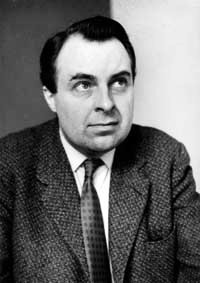
Nigel Kneale died five years ago today. To describe him as a pivotal figure in British film and television is like saying that Francis Bacon could paint a bit. Kneale was a genius, pure and simple, and was responsible for some of the cleverest, most inventive, thought provoking and terrifying stories of all time.

When I think about Nigel, about a million things all jostle to the front of my head at once, and I find it hard to present a reasoned summary of why his work is so important. All I can say is that I love him, I miss him, and then try and piece together a very inadequate tribute to his brilliance.

Sunday, 5 June 2011

Pictures Of New Towns

Hemel Hempstead in Hertfordshire was designated a new town in 1947. Originally envisaged as 'a city in a park', the first new residents moved in to the town in 1950, although the original expansion plan was not completed until the 1980's. Hemel can boast the first multi-storey car park in the UK, constructed in 1960, as well as the infamous 'Magic Roundabout', an elaborate and mystifying circulatory where six separate roads meet.

In 1957, Hammer Studios shot part of 'Quatermass 2' in the town, cannily linking Hemel Hempstead's construction to the fictional 'Winnerden Flats' being built to house workers at the 'artificial food plant' in the story. Basically a big building site, the town proved an apt and eerie location, starting with the approach on a big empty road which abruptly terminates in the middle of nowhere.


Finding a dirt track that leads to the beginnings of a huge estate, Quatermass stops to interact with a few of the locals. The lady with a speaking role is an actress, but the ladies in the background are real residents, lucky enough to have been allocated one of the few completed houses on a project that still has years to run. There isn't even a pavement for them to push their shopping baskets along.


I believe this is the area of Hemel Hempstead known as Warner's End, although I stand to be corrected. Like all the individual estates in the new town it was designed to have its own mini civic centre: a parade of shops, a pub, a Doctor's surgery, some public art. In the film, however, all they have to look forward to is Whist on Wednesdays (cash prizes), and all there is to see are the abandoned double decker buses that brought them to this brave new world. 


Incidentally, I have been to Hemel Hempstead and it's quite nice, really, with very little evidence of alien invasion.