Showing posts with label 1970. Show all posts

Saturday, 1 August 2015

What We Call The Most


'Look, Mary, no hands!'
There's no question in my mind that Cliff Richard has made a lot of good records, but very few of them have the immediate dance floor appeal of his very groovy version of 'The Girl Can't Help It' as released on his 1970 LP 'Tracks 'n' Grooves'.

The Little Richard cover puts Cliff back in touch with his rock and roll roots, of course, but it's a slightly daring move as the lyrics are ridiculously and comically lascivious, with numerous metaphors for sexual arousal and climax.

To complement the saucy words, Cliff is given a loping, slightly sleazy arrangement to emote over, full of dirty bass and, yes, prominent horns. In an attempt to temper the relentless smut, a middle eight is inserted where a Hammond organ goes all churchy and Cliff suddenly declaims 'OH, HEAR ME NOW!' as if he were a hysterical evangelist working a tent full of gyrating snake handlers.


Nice one, Clifford, nice one, son.

Saturday, 18 July 2015

A Million Horns


It’s 1970, and Cliff Richard faces up to the challenges of a new decade and a less than inspiring recent sales record by teaming up with his old pal Hank Marvin and releasing a single that is not only rockier than his usual output, but also exploits a topical theme: the unstoppable rise of the car, and the damage pollution is doing to the environment.  

Written by Hank, ‘The Joy of Living’ features an interesting guitar effect that seems to evoke the grinding futility of a traffic jam, and lyrics that are both deeply sarcastic and rather angry and are redolent of J.G Ballard (who would have thought lots of big, sexy, deadly cars a good thing) or even Patrick Hamilton (who would have thought it disastrous*). In this dystopic version of the future where the motor car is King,  man is reduced to living in state appointed high rises, looking down on the world and remembering what it felt like to breathe clean air, like a scene from the credit sequence to 'Soylent Green' come to life.

In the end, however, a strong ecological message and a jaunty chorus were not enough to propel the song  higher than number 25 in the charts and the backlash against the dirty bastard car didn’t take place after all.  As someone who was stuck in a lovely multi coloured crocodile for twenty minutes this morning, I wish the world had listened to Cliff more closely. He was also right about young ones not being young for very long.
* Hamilton had more reason than most to hate the motor car, having been knocked over and nearly killed by one in the late 1920's. In 'Coleoptera', the last chapter of his 1953 novel 'Mr. Stimpson & Mr. Gorse', he predicts a Britain over-run by cars, created by man to serve but now completely in charge of their inventors and 'pitilessly exacting' in their demands. 'The beetles were not magnanimous in victory', he notes.

Friday, 5 July 2013

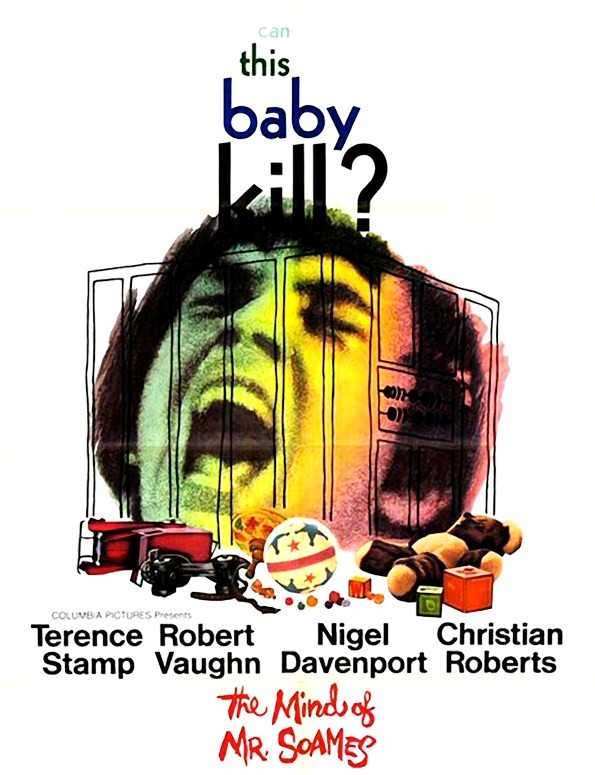
Can This Baby Kill?


John Soames (Terence Stamp) has been in a coma all of his life after something went wrong with the sleep centre of his brain when he was born. After thirty years, however, the scientific means now exist to wake him - and a medical and media machine is in place to document every minute of his second birth. Soames represents a unique opportunity to start an adult from scratch - to teach him to eat, walk, talk - and obey.

Soames soon tires of being a lab rat, and makes a break for it, clobbering an orderly on his way out. His training has not readied him for real life, however, and he finds himself in a terrifying, lonely world he is utterly unprepared for, i.e. Britain in 1970: a place where it never really gets light, curly sandwiches under plastic cloches, local train services, drunk driving and never ending, soul destroying rain. He doesn't stand a chance, poor little bugger.

A sombre, slightly worthy film, 'The Mind Of Mr. Soames' says pretty much what you might expect but says it well and has a good cast, including Robert Vaughan, Nigel Davenport, Donal Donnelly, Judy Parfitt and Christian Roberts, hugely annoying as usual. Stamp effectively reiterates his wide eyed man child shtick from 'Billy Budd', but here his usual woodenness seems to make sense - Soames is just a baby, after all, not an actor, so Stamp can just relax and set his face to gormless.

The Mind Of Mr. Soames


Saturday, 22 June 2013

Drink A Pint Of Blood A Day


‘Taste The Blood Of Dracula’ is a bit of a funny old Dracula film. Apart from a prologue which rehashes the end of 'Dracula Has Risen From The Grave' to include a scene in which Drac shares a scene with Roy Kinnear (finally!), the  undead one doesn’t even show up for forty five minutes and, when he does, everything goes downhill quickly from there.
The main story concerns three rich middle aged men (Geoffrey Keen, John Carson and, ulp, Peter Sallis) who, bored with life, have formed a kind of Saga Hellfire Club, and spend their time pursuing the ‘ultimate thrill’ (prossies, mainly, some drug abuse - 'cracking opium, Grommit!'). Overindulging in the flesh has left them jaded, however, and they yearn for something different. Enter super decadent fop Lord Courtley (Ralph Bates), a man so dastardly that working girls pay him for sex. Courtley offers the men a bargain: if they give him a thousand quid he will include them in a satanic ritual which will give them eternal life.
Intrigued, slightly turned on, they willingly fork over the cash only for Courtley to immediately give it to Roy Kinnear who, many years after his encounter with the Count, has kept his cloak, clasp, signet ring and a phial of his dried blood. With these unearthly artefacts in his possession, Courtley enacts some unspeakable rites in a deconsecrated church, climaxing in him adding blood to the dried Dracula blood and making a horrible looking cocktail with which the men are expected to drink. Thrills are thrills, but this looks like red Complan mixed with dog shit, so the men demur and, refusing to follow Courtley’s example and drink, instead beat him to death.
Courtley doesn’t stay dead too long, of course, his corpse soon transforming into Count Dracula who, for whatever reason, immediately vows revenge on the three men, a petty vendetta that seems slightly beneath him. In fact, this reincarnation of Dracula is marked by how pathetic he is: stumbling around in an ill-fitting black wig (occasionally resembling Nicolas Cage), he seems remarkably powerless, getting teenage girls (Linda Hayden and Isla Blair) to bring victims to him and, indeed, to do most of his dirty work. The climax, in which he is thwarted by a skinny kid with a couple of crucifixes, is one of the poorest of all Dracula deaths: he seemingly dies of fright, like one of those weird goats that has a heart attack if someone makes a sudden movement.
In an ideal world, this needn’t have been a Dracula film at all, it could have just been about the horrible revenge of the undead Courtley. It would have been great if he’d rampaged around killing the men in ingenious ways and introducing their daughters to all sorts of depravity before being sent back to hell by an angry mob or a priest with a shotgun or something - but then that wouldn’t have had Dracula in the title, and that’s the crux of the matter: the brand gets the audience in the cinema – after that, well, that’s their problem.

Taste The Blood Of Dracula


Friday, 17 May 2013

Whiny Dancer


‘Die Screaming, Marianne’ is a difficult film to categorise in many ways but, at heart, it’s a good old fashioned Victorian melodrama, albeit one with mod accoutrements and a heroine who works as a go go dancer.
Susan George plays Marianne ‘Hips’ MacDonald, a troubled dollybird on the run from secrets and a weird family set up (Mum is dead; half-sister hates her; Father likes his daughters a little too much). Poor Marianne believes the only thing she has going for her is her lithe body and, as a result, she freely donates it to interested parties on a regular basis. When things become complicated, she moves on, packing her pathetic little bag, slipping on her Dr, Scholl’s and moving on like a pouting, bra-less Littlest Hobo. To be honest, to use the parlance of the period, she's a bit of a drag, man. 
Her main issue is that she has the account number of a Swiss safety deposit box in which her late mother stored a number of incriminating documents about her father and, Dad, a defrocked (or whatever) Judge wants them back. Her half-sister, Hildegard (played by super skinny Judy Huxtable, soon to become Mrs. Peter Cook) just wants Maz dead, especially as she is due to inherit a lot of money on her imminent 21st birthday, money that will go to Hildegard if little Marianne is out of the way.
The film bobs along nicely for a while but, in the end, becomes a bit frenzied and confusing, albeit in an extremely languid way. I have heard that the shoot was complicated by bad behaviour from the young leads and this led to beleagured director Peter Walker having to rip several pages out of the script just to keep to schedule. That’s a shame, because although I enjoy random stabbings, car crashes, people (well, Chris Sandford, an actor I find detestable) falling down a hole and being left to die and, in particular, attempted murder by super hot sauna, ‘Die Screaming…’ never lives up to the promise of its credit sequence where Marianne, clad only in a spangly bikini and a few chains, frugs like a funky puppet to Cyril Ordanel’s groovy theme tune. If it did, we might have had something halfway decent, but it doesn't, and that's all there is it to it, I'm afraid.

Die Screaming, Marianne!


Wednesday, 27 February 2013

F*** Me, It's Freddie!


FMIF as Sweeney Todd in an episode of Thames TV's 'Mystery and Imagination' from 1970. One of Mr. Jones' few starring roles, we will return to this in the future, when we will be all over it.

Sunday, 16 December 2012

Dr. Who: The Ambassadors Of Death


‘The Ambassadors Of Death’ is an unusual, long, complex and slightly rambling story from Jon Pertwee’s first season of ‘Dr. Who’ (1970). It’s very adult in tone (no, Liz doesn’t flash her knickers, although her skirt is phenomenally short) and contrasts sequences of violent action with a slow but fascinating internecine tale of government conspiracy and xenophobia in its most expansive form, i.e. fear of (literal) aliens.
Originally written for Patrick Troughton’s Doctor, ‘Ambassadors’ is interesting for a number of reasons, not least because it makes some structural changes to the way the story is presented – little, unique touches like the recap taking in place in the middle of the credits, or the title card that reads ‘The Ambassadors’ followed by the zappy twang of a ray gun and the legend ‘OF DEATH’. The feel is different, too, darker and more thoughtful. The aliens are used sparingly and only briefly seen in their full, blue faced glory as the real villains here are humans, either mad, prejudiced men like General Carrington operating out of a warped sense of 'moral duty', or ruthless hired guns like the despicable Reegan (one of the nastiest bastards to ever appear in the programme).
At seven episodes, it is probably at least one episode, maybe two, too long, but I rather like the leisurely approach. The central element of the story clearly references the first ‘Quatermass’ story (the spaceship that goes off the radar then returns to Earth carrying something different to what it set out with), and I like that too. I also like Ronald Allen as space controller Ralph Cornish. You may remember Ronald from his long running role as David Hunter in the infamous soap opera 'Crossroads'. I love watching him in anything because he keeps the straightest possible face under all circumstances, and his permanently pained expression, combined with his deep, sonorous voice is just really funny.  I believe he was rather a fun loving chap in real life, so I like to think he's very much in on the joke. Here's a trailer --

The first two seasons of Pertwee Who are particular favourites of mine. Confined to Earth, the serious tone and reliance on location shooting on wasteground and in semi-derelict factories seems to reflect the grim milieu of early 70’s Britain (although the stories are set a few years in the future), a place permanently under siege and, it seems, under attack, a place where you can trust no-one and, as we discover in ‘Terror Of The Autons’, even an armchair can kill you.

Friday, 30 November 2012

A Phantasmagoria Of Fright


Billed as a ‘phantasmagoria of fright’, ‘Fragment of Fear’ (1970) doesn't quite live up to the hyperbole of that statement but is, nonetheless, a solid and intriguing thriller with an interesting premise, a great cast, and a fantastic soundtrack.

Tim Brett (David Hemmings) is a reformed heroin addict turned best selling confessional author who is pitched into danger when his newly discovered Aunt Lucy (Flora Robson), a kindly old woman known for her selfless work in reforming criminals is found murdered in the ruins of Pompeii. Eager to make some sense of the seemingly random killing (and with one eye to his next book) Tim sets out to find the truth, but soon finds himself the victim of those who want their secrets kept secret, and are prepared to use any means necessary to effect his silence.

Directed by Richard C. Sarafin (his next film would be ‘Vanishing Point’), ‘Fragment of Fear’ is actually really rather good, with appearances from British acting institutions like Mona Washbourne, Arthur Lowe, Wilfrid Hyde-Whyte and Dave from ‘Minder’. The screenplay (by Paul Dehn, writer of the four ‘Planet of the Apes’ sequels and, therefore, some sort of God in my eyes) is clever and literate, methodically setting out the steps by which the already edgy Tim is pushed to his very limits, and creating a paranoid world where appearances can not only be deceptive, but deadly.

An eminently watchable actor, Hemmings is in possession of a gravitas that belies his boyish face and small, slight frame, and has a calm, sonorous voice that veers between Received Pronunciation and Estuary English. He plays the brittle Tim to perfection here, making him insecure and naïve, but with more than a touch of petulance and arrogance, and a tendency towards the withering putdown and sudden burst of anger. He is particularly good when trawling the Late Night Chemists and dirty alleys where he served his junkie time, his expression a mix of disgust and longing as he joins a crowd gawking at a hapless junkie shooting up.

Ironically, it is the character’s most defining characteristic: his addiction, recovery and subsequent success as a writer, that proves to be his downfall: he is too well-known as an ex-junkie to be taken seriously, and his reports of the intimidation he is subjected to are written off as the hallucinatory ravings of a drug fiend.

A few loose ends aside, it's a cool little film with lots of cool little people and performances (Hemmings and co-star Gayle Hunnicutt were married at the time, and have an obvious chemistry), and the music (by Tom Jones and Shirley Bassey musical director Johnny Harris) is ace.

Fragment Of Fear


Saturday, 8 September 2012

Sexually Rampant Ghouls


US director Andy Milligan (1929 – 1991) is something of a legend in exploitation circles, a sort of mod Ed Wood. His films, half of which are lost, veer crazily between sex and horror and sleaze and are characterised by low budgets, poor acting and the stilted awfulness that signals the disconnect between ambition and talent.  But he made about thirty films, and you have to applaud his resolve, not to mention his sheer bloody nerve.  
‘The Body Beneath’ (1970) was one of several films Milligan made in London in the late sixties. It’s basically a retelling of ‘Dracula’ but with some very soft porn elements and an interesting twist: the vampires all belong to the same family, and the head vampire is obsessed with refreshing the degenerating blood line. It isn’t what you’d call a good film but I’ve seen a lot worse. A lot, lot worse. The basics are there: some fantastic locations (‘filmed in the graveyards of England’), occasionally  interesting camera angles and some halfway decent performances (Gavin Reed is particularly notable as Algernon Ford, the chief blood sucker, although he does remind me a lot of Reece Shearsmith from ‘The League of Gentlemen’). There’s a bit of sex, a splash of gore and a hunchback has his hands nailed to a post before being set on fire.
Strangely for this sort of film it isn’t at all boring (it’s too choppy for that), although the script makes no sense and the climactic party of the undead is rendered fairly incomprehensible by an optical effect that detracts from the action. The green faced vampires are nice, however, and, overall, it’s an interesting attempt at reinterpreting the vampire mythology on a shoestring budget and a soupcon of talent.