
Friday, 21 October 2011

Thursday, 20 October 2011
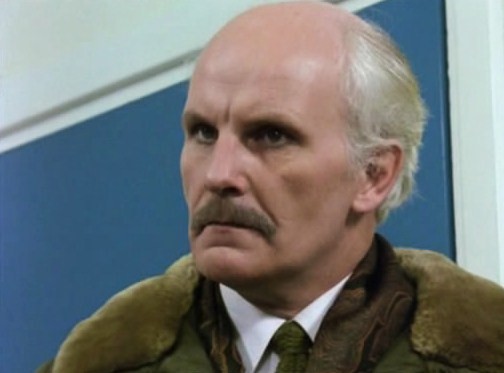
Derren Nesbitt, Actor

A young-ish (29) Derren Nesbitt as 'The Man' in taut b-movie'Life In Danger' (1964). Please note the sign behind him. It's political correctness gone non-existent.
Wednesday, 19 October 2011
Tuesday, 18 October 2011
UFO: Timelash


‘Timelash’ is a top notch ‘UFO’ episode that keeps you guessing for its duration (and beyond as, to be honest, it doesn’t make much sense in analysis).
It begins with a crazed and dirty Straker smashing up some very expensive computer equipment before a flashback reveals that, for a while, the aliens were able to freeze time and that only Straker and Colonel Lake were immune to having to act like slightly shaky waxworks. The scenes where Straker and Lake wander around the eerie, frozen studios are superbly realised - and the viewer is left genuinely intrigued as to what could be happening.
The alien plan is to destroy SHADO, end resistance entirely and then, presumably, waltz in, take over and let the transplants begin. The obvious disadvantages of leaving the defence of the entire Earth to a group of about fifty people in Boreham Wood is, as ever, up for debate, but what particularly bothers me is the fact that the aliens – who can stop time, for pity’s sake – are just so short sighted, sending one UFO to finish the job which is quite easily destroyed by Straker with the one shell he has left in his space bazooka. It’s ridiculous. & Brilliant. Absolutely brilliant.
The alien plan is to destroy SHADO, end resistance entirely and then, presumably, waltz in, take over and let the transplants begin. The obvious disadvantages of leaving the defence of the entire Earth to a group of about fifty people in Boreham Wood is, as ever, up for debate, but what particularly bothers me is the fact that the aliens – who can stop time, for pity’s sake – are just so short sighted, sending one UFO to finish the job which is quite easily destroyed by Straker with the one shell he has left in his space bazooka. It’s ridiculous. & Brilliant. Absolutely brilliant.
Monday, 17 October 2011

Sunday, 16 October 2011
Phibes Lives!

'Dr. Phibes Rises Again' isn't as coherent and fast moving as its predecessor, there aren't nearly enough killings, and it was apparently hell to make, but it's still a lot of fun.
Set three years after the first 'Phibes' film, it concerns the gruesome Doctor's attempts to track down a piece of missing papyrus which shows the location of 'The River Of Life', a mythological Egyptian stretch of water which could bring his dead wife back to him. The papyrus has been stolen by Darrus Beiderbecke (Robert Quarry), who hopes to use it to make him and his fiancee immortal (Beiderbecke is already several hundred years old but stays alive and young-ish thanks to a serum which he is rapidly running out of), so Phibes follows him across the world to kill him and the rest of his archaeological team (who, it must be said, are largely completely innocent of any crime whatsoever - they're just in Phibes way).
The dastardly Doctor has a hell of a time: training an eagle to rip John Thaw to bits - putting a scorpion down someones trousers - sealing poor old drunken chancer Hugh Griffith in a bottle - and, perhaps best of all, sandblasting Gerald Sim into a very clean heap of bones.
In the end, of course, Phibes triumphs, and the way is left open for any number of sequels which, sadly, never materialised.
The best line comes from the wonderful Terry-Thomas, playing a shipping executive furious to have been called into work at the weekend by Inspector Trout of Scotland Yard.

'We're looking for a mad man, Sir'.

'Well, you've bloody well found one! Do you realise this is Saturday afternoon?'


Saturday, 15 October 2011
Revenge Is The Best Medicine

‘The Abominable Dr Phibes’ is a huge amount of fun – cool, camp, funny, inventive, brilliantly realised, great cast, nice music (by Basil Kirchin), lots of death.
It's 1925, and the reliably magnificent Vincent Price is Anton Phibes: doctor, world class organist, inventor, aesthete and, since the terrible car accident that the rest of the world believes killed him, a hideously disfigured psychotic criminal mastermind. Phibes accident was caused by his rushing to be at his seriously sick wife’s side – he never made it and, unfortunately, she died on the operating table. Crazed by grief, Phibes vows to take bloody revenge against the eight doctors and a nurse he holds responsible, even though there is no actual evidence that they were to blame.
Phibes is, of course, no common murderer, and he brings his peculiar genius to bear on the business of dispatching his enemies, getting Old Testament on their collective arses, re-interpreting the Ten Plagues of Egypt in a series of gruesome, clever killings that knock off the team one by one by one…
You’ll get a flavour from the screen shots below of the sort of ways Phibes gets even, with bees, bats, frogs and a unicorn making telling and deadly appearances.
‘The Abominable Dr Phibes’ was directed by Robert Fuest, an under-rated talent whose star burned brightly for a short time in the late sixties and early seventies. Fuest had honed his campy, poppy style on ‘The Avengers’ (he also directed ‘And Soon The Darkness’), and the two Phibes films (yes, there’s a sequel!), and his adaptation of Michael Moorcock’s first Jerry Cornelius book, ‘The Final Programme’, show his emerging genius for interesting, stylish and skewiff genre cinema.
Sadly, Fuest suffered a nervous breakdown during the tense production of ‘Dr Phibes Rises Again’ (the sequel! Coming soon!), and avoided major productions thereafter. It’s a real shame, as not only did his illness deprive us of a unique talent, but also several more planned Phibes sequels.


Friday, 14 October 2011
Radiophonic of the Day
Not strictly a product of the BBC Radiophonic Workshop (i.e. not at all), but this version of the 'Doctor Who' theme by violinist Don Harper has the right pedigree and, of course, the requisite funny noises, to be featured.
Thursday, 13 October 2011
Dr. Who: In The Matrix


From 'The Deadly Assassin'. The Matrix may not look all that terrifying now, but when you're eight it has a much bigger impact...
Dr. Who: The Deadly Assassin


‘The Deadly Assassin’ takes us to the Doctor’s home planet of Gallifrey for an extended stay and, to be honest, we get a fair idea of why he left: it’s really boring, like a sort of intergalactic Brussels filled with pompous bureaucrats and over-zealous security guards. No wonder he nicked that type 40 Tardis and went off in search of adventure.
The Doctor has been drawn there to act as a patsy for the planned assassination of the President of the Time Lords, a plot that has the horrible, gnarled fingerprints of a very emaciated Master all over it (the Master is literally falling apart, having reached the end of his last regeneration). The overarching story is rather dull, basically ‘The Manchurian Candidate’ with crappy lasers and even more internecine politics, but it is redeemed by, for me, the most memorable twenty minutes of TV broadcast anywhere in 1976.
In order to prove his innocence, the Doctor must enter The Matrix – a virtual world of the mind where anything can happen (as long as it’s not too expensive looking) and this provides a number of really cool scenes as the Doctor fights for his life against crocodiles, Samurai, WW1 snipers and bi-planes in a bizarre dream like environment of jungle, quarry and swamp.
I found it absolutely thrilling as a kid and, although it shows its limitations now, I still think it’s a brilliant sequence – one bound to fire the imagination of any reasonably bloodthirsty and thrill hungry child.
The Doctor survives, of course, the moribund Master gets away and the boring civil servants of Gallifrey rewrite history so that none of it ever happened. Like many trips home, it’s proved to be a tiring and soul sapping experience, leaving you with a desperate urge to go somewhere exciting and meet an aggressive woman in an animal skin bikini.
Wednesday, 12 October 2011
Dr. Who: The Hand Of Fear


‘Hand Of Fear’ is probably most notable for marking the (first) departure of Sarah Jane Smith after two Doctors and an awful lot of screaming, although it’s also a pretty peppy story which traverses 150 million years and two galaxies.
The TARDIS materialises in a quarry on Earth (one of the few times in the series a quarry on Earth is just that) just in time for Sarah Jane to be buried in an explosion. When they dig her out, she is clutching a fossilised hand. The hand belongs to Eldrad, an alien super villain from the distant past. Apparently dead, the hand exerts a malign influence over Miss Smith, later using a massive dose of nuclear power to reconstitute itself into a rather foxy silicon based life form, a curvy, haughty charcoal briquette.
Forcing the Doctor to take her back to her own planet, Eldrad is killed by a trap set for her by the long dead people of her now empty world of origin. Undaunted, she reconstitutes herself into a much bumpier, even more bonkers male who, realising there is nothing left for him on his own planet, decides to return to Earth and conquer us instead, the cheeky bastard. The Doctor’s not having this, of course, so he trips him up with his scarf and sends him plummeting into a bottomless pit. End of.
Subscribe to:
Posts (Atom)