Showing posts with label Bracknell. Show all posts

Saturday, 24 November 2012

The World Of The Nightmare


David Greene seemed like one of Britain’s most promising directors in 1969. After a decade in TV, Greene had made the transition to films with odd horror thriller 'The Shuttered Room' in 1967, rapidly following up with brilliant espionage romance 'Sebastian' and policier 'The Strange Affair' (see yesterday) in 1968. Although none of his films could be called masterpieces, he definitely had something, a way of taking standard, even clichéd, genre material and giving it a Carnaby Street paint job and a fresh and trendy cast of pretty semi-freaks: a sort of psychedelic-lite approach to film making.

‘I Start Counting’ (1969) was his last British film, and its critical and commercial failure drove him to America, where he stayed working in TV until his death in 2003. The film itself has a mixed reputation, is not available on DVD, and has not been shown on telly for many years, but is hardly the disaster Greene thought at the time.

Wynne (Jenny Agutter) is a 15 year old school girl with a desperate crush on her older foster brother George. Their family is pleasant, but slightly dysfunctional: fatherless, and crammed together in a small flat on a featureless new estate. In her spare time, Wynne goes back to their old, abandoned family home in a nearby wood and happily reverts to early childhood, playing house and swinging aimlesly on the rusty swing.  A series of small incidents lead Wynne to suspect that George might be the perpetrator of violent sex crimes that have taken place in the area and, desperate to show him her maturity, and heedless of the danger, she sets out to investigate.

An odd little film that ultimately appears not to have a point, ‘I Start Counting’ meanders from scene to scene at a sombulant pace, throwing up lots of dead ends and unanswered questions. The script was adapted from a moderately successful novel of the same name, but the nuances and psychological twists and turns of the written word seem to have been lost in the journey from page to screen. It’s a well-made film, but gives very little to the viewer in terms of genuine suspense or insight, although historians and sociologists and mid-century enthusiasts like me may value its portrayal of New Town Britain* in the late 1960’s, and record enthusiasts (like me) enjoy the scenes set in a groovy disc emporium, complete with West Coast Pop Art Experimental Band LP’s and space age plastic bubble listening posts.

The most notable feature of the whole venture is the star, Jenny Agutter, although it’s also the most problematic. Agutter was 17 during filming but, in school uniform, she looks considerably younger than even the 15 year old character she is playing, and the emphasis on her sexual attractiveness in both the film and its attendant publicity material seems unacceptable today.


Island Idol Basil Kirchin provided music for three out of the four films Greene made before he relocated to the states, including 'I Start Counting', and here's the opening sequence with its beautiful, wispy title song, as sung by Lindsey Moore.


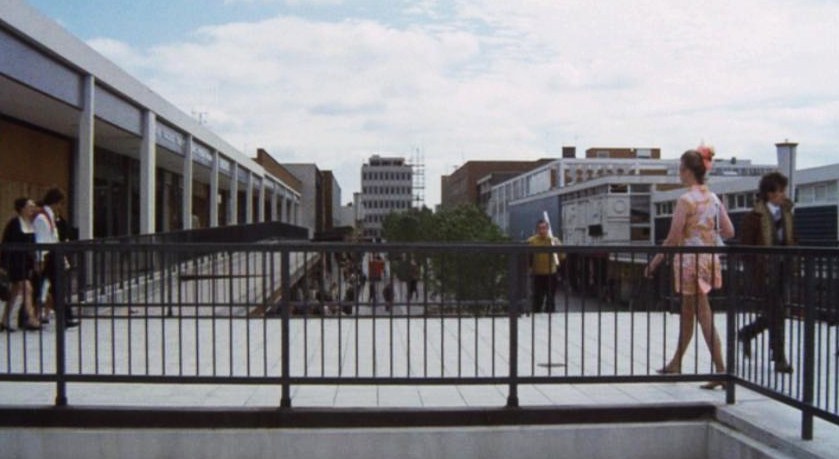
* It was filmed in Bracknell in Hertfordshire, like 'I Want What I Want' and 'The Offence' from a few years later. Part Utopia, part work in progress, everything seems to be under construction, a new world in the making. The church that Wynne attends looks more like a space age bachelor pad than a place of worship, and it's slap bang in the middle of a building site. See 'Bracknell' tab at the bottom of this post for more stuff about the place.

I Start Counting


Saturday, 30 July 2011

It's All Too Much


I first saw 'The Offence' in the late eighties, coming in at midnight after a night at the pub and flaking in front of the TV to watch the Friday film. I think I had some chips with me. By the time it had finished, I was completely sober and deeply depressed: it's pretty serious shit, and I just wasn't prepared for it.

One of the pet projects Sean Connery got to make for returning to the Bond franchise in 'Diamonds Are Forever', 'The Offence' was directed by the brilliant American film maker Sidney Lumet, although it's very much a British film. Shot on location in Bracknell, it shows us the aftermath of a fatal interrogation by a veteran Police Officer who simply cannot cope with the pressure anymore. When he questions a suspect in a child rape case the parallels between them are too much to take, so he beats him to death in anger and disgust and a sudden burst of self-awareness.

Imbued with a creepy, clinging atmosphere of foreboding, it's by no means an easy film to watch, and is certainly not recommended to those of a morbid disposition. But then that's the point, isn't it? It's an olive, grey and brown world of suicide, murder, rape and abduction, rain and mud and unhappy marriages and poky flats and dead kids and too many cigarettes and sheepskin bloody coats and stewed tea and 'Please, Sir' and killing a man because he knows what's inside you...what did you expect, a musical comedy?

The Offence


Monday, 23 May 2011

Pictures Of New Towns

We're back in Bracknell new town for a look at some of the locations used in the 1972 film 'The Offence'.

The film is a pretty powerful psychodrama about a veteran police officer (Sean Connery) who has seen too many horrors and broken too many rules and no longer feels a distance between himself and the criminals he pursues. When he interrogates a suspect in a child rape case, his self-loathing boils over into sudden and fatal violence. It's a very dark film, and I'll come back to it when I gather the nerve.

Here's Bracknell by day, specifically the Wild Ridings estate. It looks pretty bleak, but then it's supposed to. Clearly under construction, I doubt it's quite as spacious and under-populated these days as it was in 1972.


Here's Bracknell by night, an even grimmer proposition. Apart from the Police, the civic centre seems entirely populated by snitches, drunks and paedophiles. I can't imagine this did anything for Bracknell's public image, although snitches, drunks and paedophiles might have thought it their kind of town.


Roy from 'I Want What I Want' worked in an office up there somewhere, poor devil. No wonder he was so confused.

If you're ever troubled by anyone running on about flares and Aztec bars and how much bloody fun the seventies were I would strongly suggest showing them 'The Offence' and asking them to point out just where the 'fun' elements are in this production. The cold, empty streets? The constant threat of violence and perversion? The lonely cinema showing 'Please Sir'?

Monday, 2 May 2011

Pictures Of New Towns

Bracknell in Berkshire was designated a new town in 1949. Over the years it has served as a location for a number of films, including something called 'Larry Potter'. In 1972, however, it featured in the early scenes of 'I Want What I Want'.

The elevated walkways of the town centre seems to take the 'streets in the sky' concept used in highrise housing and apply it work and leisure, although the complex labyrinth of railings and ramps provide a nice metaphor for Roy's imprisonment in a male body and the small town attitudes that will drive him away.


Much of Bracknell still seems under construction in the film, and the image of the new escalators on a patch of concrete in a building site is pretty striking. 


Out of town, the housing estates are similarly half-made up, judging by the temporary bus stop and piles of rubble. The houses look nice, though, although this beast is presumably at the upper end of the scale. There are no streets, roads, avenues, closes or crescents in Bracknell, only names, alphabeticised depending on which of the estates they are on. I supposed you get used to it.


We'll come back to Bracknell again soon but, until then, we'll take the escalator to who knows where and say TTFN.

Thursday, 28 April 2011

Pantie Hose, 5/11


A selection of 'I Want What I Want' lobby cards.

I'm Different To Most Boys


About six or seven years ago, I picked up a tatty second hand paperback called 'I Want What I Want' by Geoff Brown. In it, a teenage boy called Roy is struggling with his over-riding desire to be a woman. When his unsympathetic Dad catches him in high heels and make up, Roy moves away to a rented room where, in anonymous solitude, he perfects his real self, Wendy. For a while he lives and dresses as a woman, making friends who have no idea of his true identity. When Wendy falls in love with a brutish games teacher called Frank, however, her secret life starts to unravel pretty quickly.

Overall, it was a slightly trashy but absorbing read. I even wrote a song about it for a friend of mine to perform. When I found out they'd made a film of the book, my head nearly exploded. Ridiculously, it has taken me until now to track a copy down and, although it's no masterpiece, it's a fascinating piece of work.

Made in 1972, it stars Anne Heywood in the dual (well, sort of) role of Roy and Wendy. Anne is slightly too mature for the role and doesn't look much like a man, to be honest, but then Roy is slight and finely featured. As Wendy, however, Anne uses her voice and some clever make up to pull off the difficult acting trick of being a woman who is a man who looks like a woman.

The film is choc-a-bloc with great period detail and transplants the books locations of Beverley and Hull to Bracknell and London. Bracknell was a new town (it's still under construction in some of the location shots), and can also be seen in other 'Island' favourites 'I Start Counting' and 'The Offence'. I might do a feature about it one day.

There is one crucial difference between the book and the film: on paper, it ends abruptly with the chillingly ambiguous sentence 'I fell down the stairs'; on film, there is something approaching a happy ending. That said, both versions feature a woman trying to cut her penis off.

Here's the trailer. It's in Spanish, but I rather like that about it.


Two final facts pertaining to the film: it was apparently the first mainstream film to include a sympathetic portrayal of a trans character , and Anne Heywood's real name is Violet Pretty, which is quite charming, especially as she was the 1950 Miss Great Britain.  

I Want What I Want