Thursday, 11 July 2013

People Apart


'People Apart' is a 1957 documentary film which attempts to demystify that most mysterious and terrifying of illnesses, epilepsy. It's aims are succinctly summed up by the above title card.

Here, an actor completely commits himself to demonstrating some of the physical symptoms of an attack.


These may look like snapshots from a torture chamber with a hair salon attached, but they actually depict an attempt to help and understand - albeit one that involves diodes and induces an epileptic seizure.


Fascinating, frightening stuff, brilliantly and sensitively realised.

Wednesday, 10 July 2013

Oddments


"Well, I could use the other phone, but then I'd have to change my glasses..."

Interesting Postcards


The Globe,
Swanage,
Dorset

I think this is definitely an interesting postcard but, apart from making an obvious remark about women in Dorset liking massive balls, I don't really have anything interesting to say about it. So there.

Tuesday, 9 July 2013

The Commonwealth Institute

Ah, The Commonwealth Institute in Kensington, the trendy, liberal cousin of the British Museum that eventually came a cropper. Whereas the British Museum is full of artefacts stolen from the natives, The Institute showcased items donated by our extended international family, not least the 25 tonnes of South African copper that comprise the distinctive ‘hyperbolic parabaloid’ roof.


Built as a showcase for trade between Commonwealth partners, it was designed by Sir Robert Matthew, who had worked as a London City Council architect from 1946 to 1953 and played a massive part in the Festival of Britain, as well as co-designing the Royal Festival Hall. Started in 1960, it was opened by The Queen in November, 1962. It comprised an administrative wing (it was a real Institute, not just a pretend one), and a large diamond shaped exhibition space with an art gallery and cinema attached, all set in ornamental gardens with walkways and waterways. It’s a lovely building, very 1962.


The exhibition itself was designed by James Gardner, who had created the exhibition inside The Dome of Discovery at the Festival of Britain, which looked at life on our small planet, and the proportionally enormous part Britain had played to date (sections included The Earth, Outer Space, Sky, Polar, Sea and The Land). The Commonwealth Institute’s exhibition was similarly comprehensive, with stuff from all the formerly pink bits on the map, all willingly given in the spirit of the new age of equality of peoples and a spirit of co-operation.

In 2000, the ownership of The Institute shifted from the Foreign Office to a Trust, the architectural equivalent of a football manager receiving a vote of confidence from the Chairman. It closed two years later and has remained closed ever since. Here it is in its rather sad, vacated state.


In 1969, the ITV kids show ‘The Tyrant King’ (which was basically a tourists guide to London and the suburbs), filmed several key scenes at The Institute, and the following screenshots give a flavour as to what it looked like with stuff in it. I love the central hub, although it is very frustrating that everyone in the programme who passes the centre looks down, and I have no idea what they are looking at.


The Hub

Not part of the permanent exhibition

The late Phillip Madoc checks out some ethnic art 

Some sort of African exhibit

Another sort of African exhibit

How much did Modernists love stair cases?
The building is due to reopen in 2014 as the new home of the Design Museum, although the interior has, apparently, been significantly remodelled. I wonder if there will be a place for a model of a Hong Kong junk, or a set of African drums? I hope so, but I very much doubt it (the majority of the exhibits were returned to their places of origin).

Speaking of Design, here’s the flag of the Commonwealth, a classic of simplicity and good taste, although I'm not sure it’s a coincidence that the beneficent golden glow encircling the earth has a gap where Russia and China are.    

Monday, 8 July 2013

Valerie Leon, Show Girl


Valerie Leon has a small but pivotal role as a showgirl in the Randall & Hopkirk (Deceased) episode 'That's How Murder Snowballs'. She's a fine looking woman. I'd pay money to see her standing around in a feather head dress.

Saturday, 6 July 2013

Random Quest


‘Quest For Love’ starts off in a blur of 1971 type activity, all polo necks, suede jackets, casual racism and sexism and Denholm Elliot wearing a massive lopsided suit jacket to convince us he only has one arm. In a matter of minutes, bony physicist Tom Bell has had a mishap in the lab and been transported to a parallel timeline. It’s 1971 here, too, but little things are different: the economy is booming because World War Two never happened, Denholm Elliot has two arms, and Tom is a best selling author who is unhappily married to Joan Collins.
Of course, Tom is still a bony physicist in his own head, he has just apparently swapped places with an alternate self who is, presumably, out in the other 1971 fucking experiments up. Our Tom realises several things about the man he is supposed to be, not least the fact that he is a vain, selfish dickhead who treats his wife like rubbish. Our Tom loves her, however, and spends most of his time trying to convince her he is different. As soon as he does, and they fall in love, she dies, and the trauma projects him back to his own timeline. Realising that there must be a Joan equivalent in this 1971 as well, perhaps with the same heart complaint the other Joan had, he tries desperately to find her and save her - and get off with her – the quest for love of the title (although this bit only lasts about ten minutes).
If you forget all the quantum stuff and Denholm Elliot’s big, skewiff jacket, ‘Quest For Love’ is an entertaining film that reminds me a little of some of the more outré US soap operas (the ones with evil twins and flashbacks within flashbacks within comas). It’s particularly good in making two of the most unsympathetic leads of all time seem almost lovable: Tom Bell, who despite slightly resembling my Dad, is usually a sinister, sardonic presence and Joan Collins who is undeniably very attractive in physical terms, but always seems like a MASSIVE pain in the arse in almost every other respect.
A surprisingly commercial mix of sci fi and love story, ‘Quest For Love’ was based on a John Wyndham story called ‘Random Quest’, and was a non-portmanteau product of the wonderful Amicus studios. Watch it, you’ll enjoy it. 


Quest For Love


Friday, 5 July 2013

See Tom Run


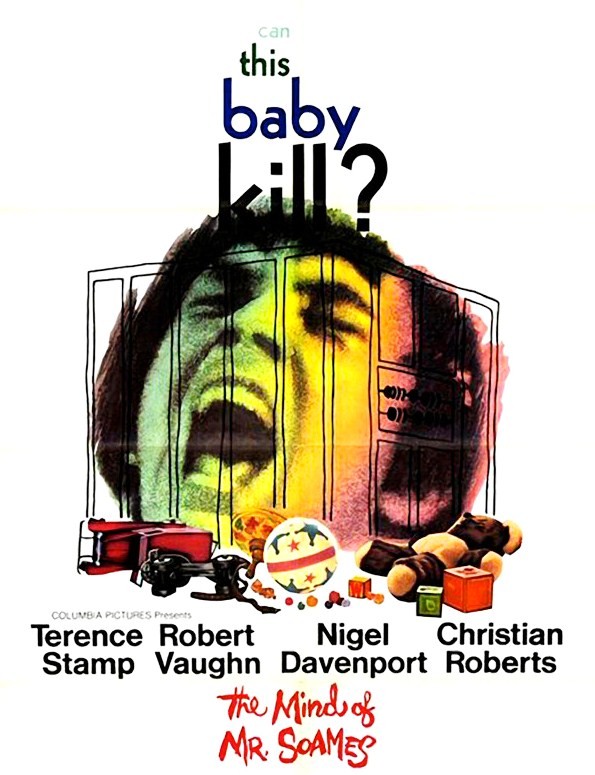
Can This Baby Kill?


John Soames (Terence Stamp) has been in a coma all of his life after something went wrong with the sleep centre of his brain when he was born. After thirty years, however, the scientific means now exist to wake him - and a medical and media machine is in place to document every minute of his second birth. Soames represents a unique opportunity to start an adult from scratch - to teach him to eat, walk, talk - and obey.

Soames soon tires of being a lab rat, and makes a break for it, clobbering an orderly on his way out. His training has not readied him for real life, however, and he finds himself in a terrifying, lonely world he is utterly unprepared for, i.e. Britain in 1970: a place where it never really gets light, curly sandwiches under plastic cloches, local train services, drunk driving and never ending, soul destroying rain. He doesn't stand a chance, poor little bugger.

A sombre, slightly worthy film, 'The Mind Of Mr. Soames' says pretty much what you might expect but says it well and has a good cast, including Robert Vaughan, Nigel Davenport, Donal Donnelly, Judy Parfitt and Christian Roberts, hugely annoying as usual. Stamp effectively reiterates his wide eyed man child shtick from 'Billy Budd', but here his usual woodenness seems to make sense - Soames is just a baby, after all, not an actor, so Stamp can just relax and set his face to gormless.

The Mind Of Mr. Soames


Thursday, 4 July 2013

A Field Near You


From July 5th, Ben Wheatley's new film 'A Field In England' will be available to watch in cinemas, on Film Four, on DVD and Blu Ray and on things called Video On Demand sites. 

Wheatley is the most exciting film prospect this country has had in years, and I find the promise of his latest work, with its 'Witchfinder General' hats, magick, mushrooms and madness, so exciting that I shall be going to bed early tonight just to make tomorrow come quicker.


Just in case you're still not decided, here's a trailer that Julian House did for it. The first time I saw this I had to hold onto something to stop myself from swooning. 

Wednesday, 3 July 2013

It's A Small World


The Miniature Village,
Eastbourne,
Sussex.

Fairly standard fare, but nicely done and very pretty on a nice day, I expect. I'd estimate the population at around 150, so why they need three churches is anyone's business. Probably a denominational thing: one's C of E, one R.C and one National Progressive Spiritualist.   

Tuesday, 2 July 2013

The Prisoner: Dance Of The Dead


'Dance of the Dead' is a strange ‘Prisoner’ episode, a vague amalgam of various themes executed in a fair to middling way, neither a notable success nor a flop. It has good bits, and weird bits (the radio broadcast; the trial), and a great new Number Two (played by frail but feisty veteran actress Mary Morris), but it doesn’t hang together particularly well and, as such, is nowhere as memorable as other episodes.

When I tried to recall the plot of this one, for instance, I came up with three basic elements: something about a trial, Number Two in a Peter Pan costume and Roland Walter Dutton. I don’t know why I should remember an incidental character’s full name other than everyone keeps saying it all the time. It’s even written down at one point. Brains are funny things, aren’t they? Well, when they’re on your side, that is. There’s nothing funny about your brain turning against you, believe me.

When I re-watched the episode, I was additionally struck by the attempt to present more composed, ‘artistic’ shots, by how very cool Ms. Morris is, and, on a Ms. Morris coolness related note, the final scene in which Number Six says to Number Two ‘I’ll never give in’. The not particularly bothered Number Two smiles and says ‘then how very uncomfortable for you, old chap’. A killer line, and a very perceptive analysis of the situation. Just for a second, I’ll bet Six felt like a right chump.

Monday, 1 July 2013

W Is For Wyngarde


Peter Wyngarde could have been Doctor Who, you know. He has presence, authority and eccentricity. He is obviously intelligent, and looks fantastic in Edwardian costume. I can imagine that he would have been acerbic, snappy, sometimes cruel - fond of eloquent speeches, merciless in his contempt for evil, camp as hell. That never came to pass, unfortunately, but in 1984 he did finally turn up in the programme as Timanov, the religious leader of a group of people called the Sarns who live on a volcanic 'Planet Of Fire'. i.e. Lanzarote.  


To be honest, 1984 is two years beyond my cut off date* for Doctor Who, so I only remember this story from seeing a bit with a young woman in a bikini (pervy fan fave Peri)and thinking 'well, she's a bit better looking than Adric'. Having watched it again in its entirety for this post, I have little to add to my earlier assessment.  Not a good or even coherent story, the tedium / confusion is relieved by Mr. Wyngarde, of course, who isn't onscreen much but still gives a typically assured performance, even though he has a load of rubbish to work with. The thing is that Peter is a proper actor, so it doesn't matter whether he's wearing a keffiyeh, a pirate hat or a gorilla suit - you're always going to get a performance out of him. He's a Genius.  


* I stopped watching the show in 1982 for several reasons, not least because the BBC had moved it to twice a week (on Tuesdays and Wednesday evenings) and I was doing other stuff (girls, riding my bike, riding my bike to girls) and I just lost track. My defection coincided with a particularly poor period for the show (although it would get much worse) and a new Doctor (Peter Davison) I didn't in any way dislike but just couldn't quite believe or get excited about. The passage of time has not changed my mind.